
Aquarium filter comparison
Canister Filter vs HOB Filter: How Do They Work Differently?
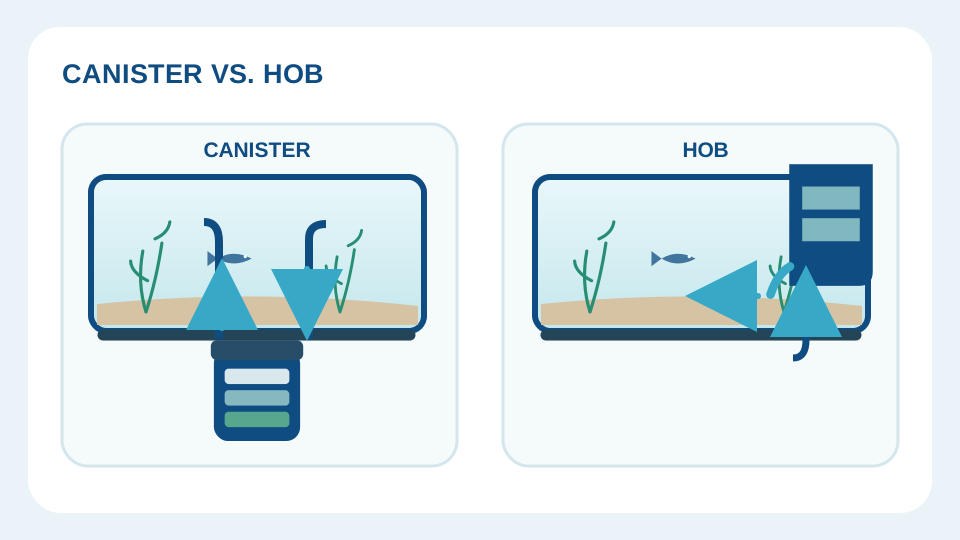
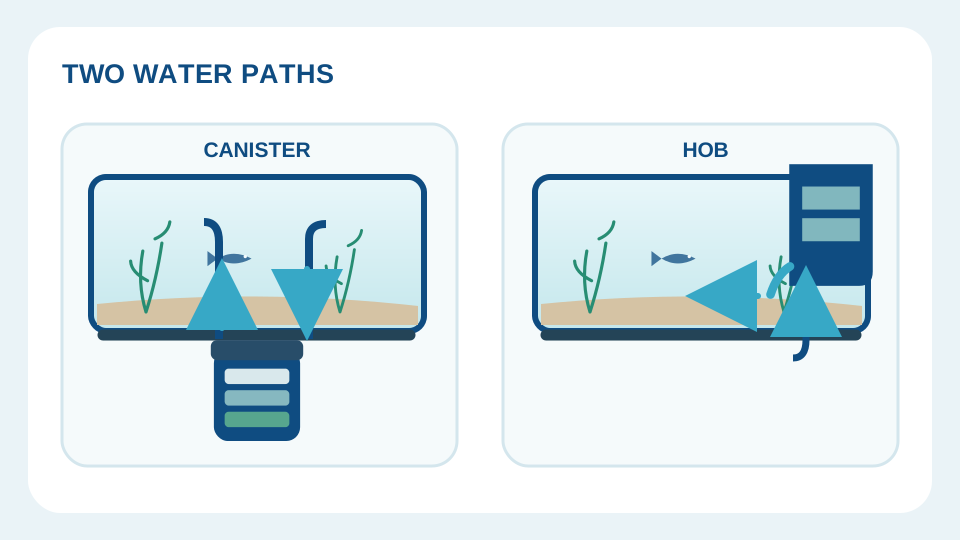
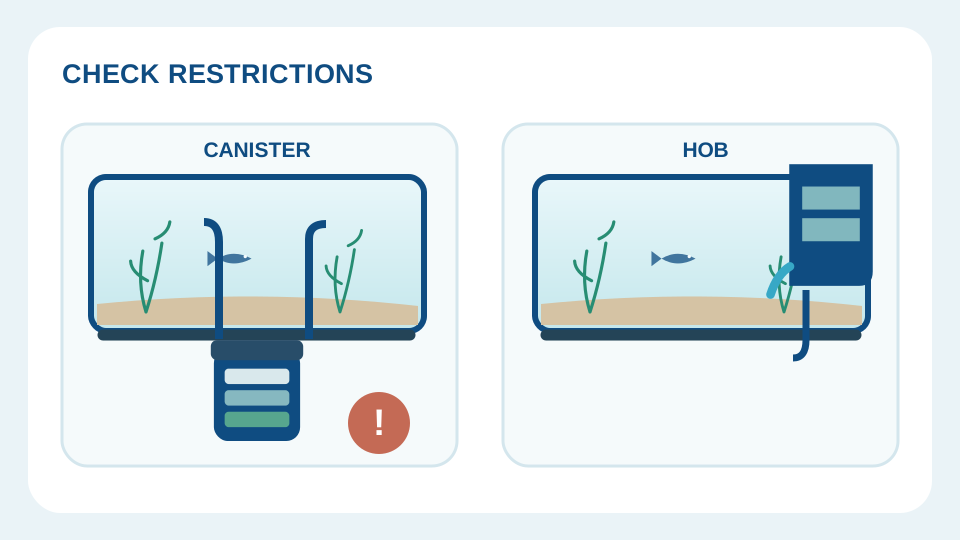
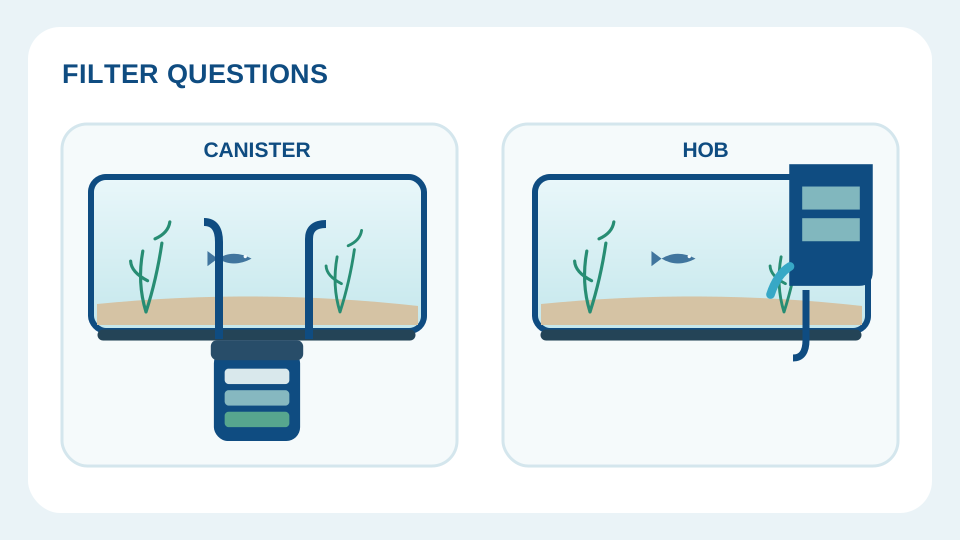
Both canister and hang-on-back (HOB) filters can clean aquarium water effectively. Their architecture is different. A canister uses a sealed chamber, usually below or beside the aquarium, with hoses carrying water in and back. A HOB hangs on the tank rim, lifts water into its media chamber, then returns it directly over an outlet lip.
That difference affects media capacity, flow placement, maintenance, noise, and the space each setup needs. Neither design is automatically superior. Compare the actual filter, livestock, waste load, and maintenance you can manage before choosing.
At a glance
Quick Reference
Swipe the table to compare both filters.
| Factor | Canister | HOB |
|---|---|---|
| Position | Usually below or beside tank | On tank rim |
| Water path | Intake hose → sealed chamber → return hose | Intake tube → media → direct return |
| Media capacity | Usually larger | Usually smaller to moderate |
| Customization | High | Model-dependent |
| Maintenance | More involved access | Usually easy access |
| Surface movement | Depends on return | Often noticeable |
| Noise | Often low when primed | Motor and possible waterfall |
| Visibility | Body can be hidden | Body behind tank |
| Setup | More steps | Fewer steps |
| Typical strength | Capacity and configuration | Access and simplicity |
These are category-level tendencies, not guarantees. Individual designs differ.
Overview
Canister Filter vs HOB Filter at a Glance
Both designs can use mechanical media to trap suspended debris and biological media to support bacteria that process ammonia and nitrite. Chemical media, such as activated carbon, is optional and depends on the chamber and purpose. The important difference is how water moves, how much media fits, where the body sits, and how the keeper reaches it.
A well-configured HOB is a real biological filter, not merely a small canister substitute. A canister's larger body can offer flexibility, but that extra space helps only when flow, media, and maintenance suit the aquarium.
| Question | Canister | HOB |
|---|---|---|
| Mechanical filtration? | Yes | Yes |
| Biological filtration? | Yes | Yes |
| Chemical media? | Optional | Usually possible |
| Media customization? | Usually extensive | Depends on model |
| Body in aquarium? | No; only intake and return parts | No; body attaches to rim |
| External hoses? | Usually yes | Usually no return hose |
| Frequent access? | Less convenient | Convenient |
How Does a Canister Filter Work?
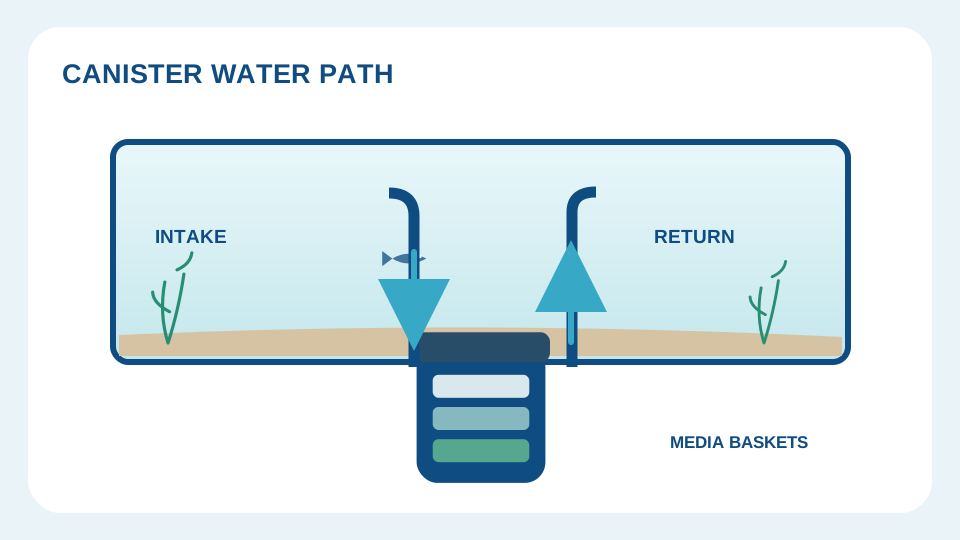
- Water enters an intake strainer in the aquarium.
- An intake hose carries it into the sealed canister.
- Water passes through one or more media stages; the exact internal route varies by model.
- Mechanical media catches particles, while established biological media hosts nitrifying microorganisms.
- Optional chemical media addresses particular dissolved substances when needed.
- The pump sends water back through a return hose.
- A nozzle, lily pipe, or spray bar distributes the return inside the tank.
The chamber often has multiple baskets and more physical media space than a comparable HOB. Most of the body can be hidden in a cabinet, and the separate return gives placement choices. These benefits also add hoses, seals, valves, and setup steps to inspect.
Manufacturers specify an installation-height limit, sometimes alongside a pump's head rating. In a properly primed closed-loop canister, the descending intake largely balances the rising return; the height difference is not simply subtracted from flow as though the pump were lifting water from an open bucket. Stay within the model's limits for pressure and priming. Hose length, bends, media, and debris still create resistance, so operating flow can differ from an advertised pump rating.
How Does a HOB Filter Work?

- An intake tube reaches down into the aquarium.
- A pump moves water into the rim-mounted filter body.
- Water crosses the installed media, following the route designed for that model.
- Filtered water spills directly from the outlet into the tank.
HOB means hang-on-back. Some units use disposable cartridges; others have reusable foam, separate biological media, customizable baskets, or loose media bags. Cartridge replacement is not a universal requirement. Product features may also include adjustable flow, surface skimming, multiple intakes, or self-priming operation.
The direct return often disturbs the surface, particularly when water falls through a noticeable gap. That movement can support gas exchange, but its strength depends on water level and outlet design. A HOB still needs suitable intake protection for fry or shrimp, and an open outlet is not ideal for every fish that prefers calm water.
The Biggest Difference: Water Path
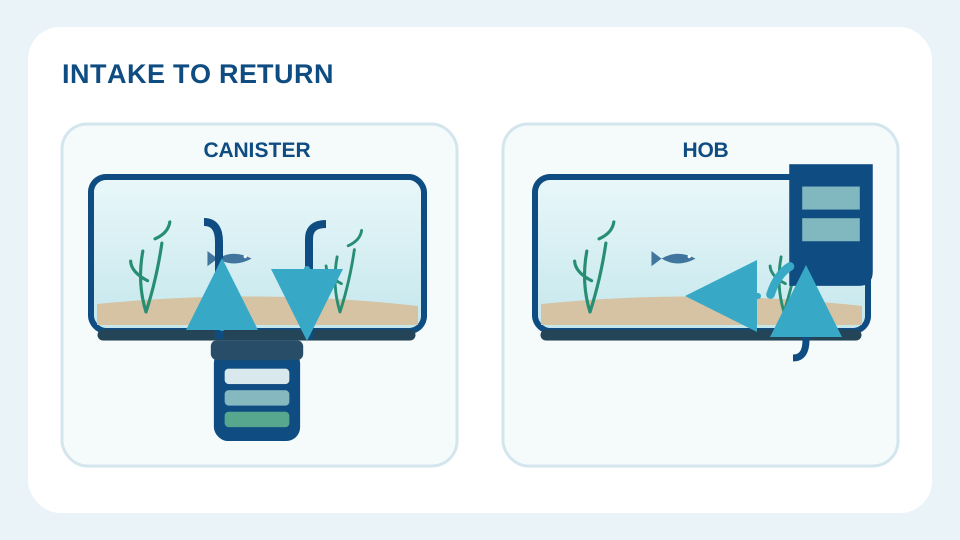
The canister takes aquarium water to a separate sealed housing and returns it by hose. The HOB lifts water into a housing mounted directly on the rim and lets it return over that housing. This architecture explains much of the difference in media volume, access, plumbing, and surface movement.
| Stage | Canister | HOB |
|---|---|---|
| Intake | Pipe and hose | Pipe beneath filter |
| Housing | Separate sealed body | Rim-mounted body |
| Media route | Often longer, enclosed | Usually shorter, accessible |
| Return | Hose and chosen outlet | Direct overflow |
| Surface effect | Outlet-position dependent | Often visible agitation |
| Access | Disconnect and open | Usually open from top |
Filter Media Capacity and Customization
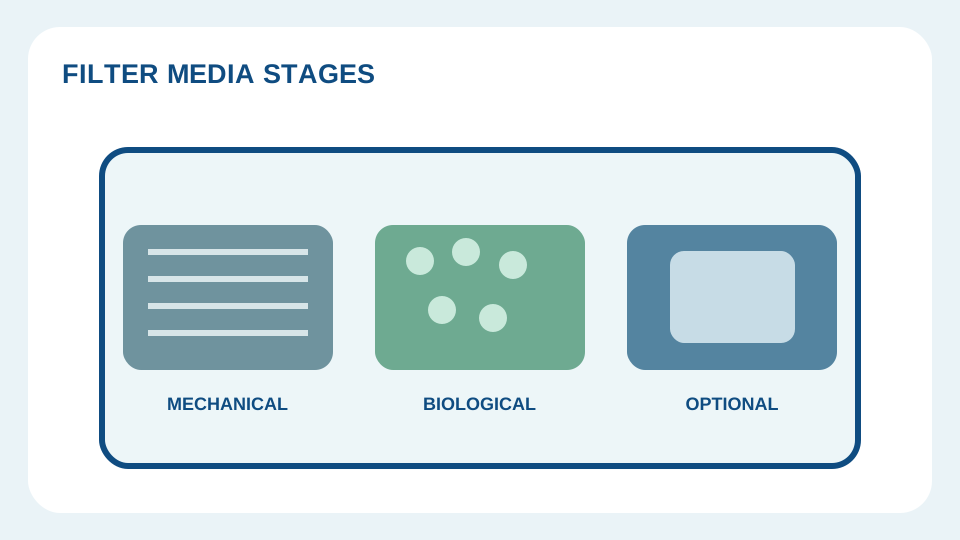
Canisters commonly have more physical room for several stages. That does not mean a HOB cannot be customized: a roomy basket can hold reusable foam and biological media, while a small cartridge-only unit may give fewer choices. Compare actual media volume and water routing rather than relying on the category label.
Mechanical Media
Coarse and fine foam, polishing pads, and filter floss trap particles. The best order follows the device's real water path, which varies among models. Clogged pads reduce flow, so accessible cleaning matters as much as initial capacity.
Biological Media
Ceramic rings, sintered materials, reusable plastic media, and even established foam offer surfaces for beneficial microorganisms. Biological performance also depends on oxygenated flow, aquarium maturity, feeding, stocking, and maintenance. Adding more dry media to a poorly circulated or neglected filter will not automatically improve water quality.
Chemical or Specialized Media
Activated carbon or purpose-specific adsorbents can be used when there is a clear reason and enough chamber space. Neither filter type needs carbon in every setup. Follow the medium's instructions and account for when it is exhausted.
| Media factor | Canister | HOB |
|---|---|---|
| Physical space | Generally high | Low to moderate |
| Multiple stages | Common | Model-dependent |
| Reusable foam | Common | Common on many models |
| Biological media | Easy to accommodate | Often possible |
| Chemical media | Easy to accommodate | Space-dependent |
| Configuration | Usually extensive | Varies greatly |
Flow Rate and Water Circulation

Gallons per hour (GPH) or liters per hour (LPH) describe water moved under stated test conditions, not an entire filter's quality. Canister hoses, elevation, media, and dirt can lower operating flow. A HOB's loaded cartridge or clogged intake can do the same. Read the maker's rating method where available.
Filtration flow is water passing through media. Whole-tank circulation is movement around plants, rocks, and corners. A filter can process a useful volume while debris still settles behind driftwood. Return direction and tank dimensions matter, as do fish that prefer calm water.
- Match current to livestock and aquascape.
- Observe dead spots as well as the filter outlet.
- Compare freshly cleaned and dirty-flow conditions.
- Use turnover guidance as a starting point, not a universal rule.
Surface Agitation, Oxygenation, and CO₂
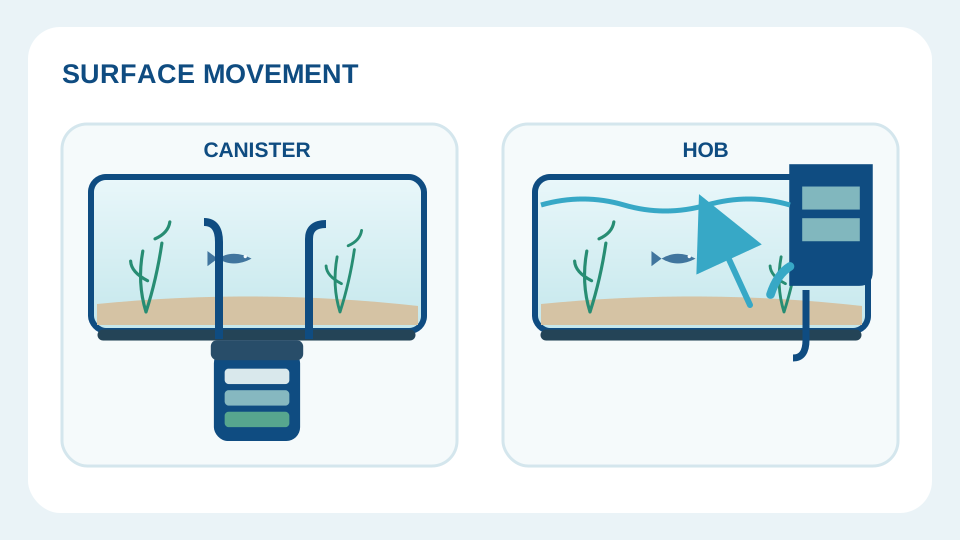
A HOB's return often breaks the water surface, especially when the water level sits well below its lip. This may disrupt surface film and promote gas exchange. A canister can also create strong surface movement with a well-aimed spray bar or nozzle, or a gentler ripple with a submerged return. Filter type alone does not determine oxygenation.
In a planted aquarium using injected CO₂, excessive splashing can increase carbon dioxide loss. That does not mean the surface should be still. Fish and microbes still need oxygen exchange. Set the return to provide useful circulation and a sensible ripple, then observe plant growth and animal behavior.
What Matters More Than the Label?
- Return angle and depth
- Aquarium water level
- Actual surface movement
- Stocking and plant mass
- CO₂ schedule, if used
Maintenance: Which Is Easier to Clean?

A HOB is usually quicker to open. Stop it, lift out media, rinse reusable mechanical material as directed, inspect the intake and impeller, then restart it. Replace only exhausted or damaged media that actually needs replacement. Preserve useful biological media rather than discarding everything on a generic schedule.
A canister service may add valve closure, hose disconnection, moving or opening the body, cleaning multiple baskets, inspecting seals, and re-priming. Its larger media reserve can sometimes lengthen the time between services, but it also makes each service more involved. Follow the exact maker's sequence to avoid spills or trapped air.
| Issue | Canister | HOB |
|---|---|---|
| Media access | More involved | Usually very easy |
| Hose cleaning | Periodic | Usually not applicable |
| Impeller access | Model-dependent | Often simple |
| Spill risk | Higher if mishandled | Usually lower |
| Dirty media visibility | Hidden | Often easy to inspect |
| Service session | Often longer | Often shorter |
Watch for reduced flow, clogged pads, debris buildup, and abnormal noise rather than applying one fixed cleaning interval. Keep biological media wet during ordinary service and avoid aggressively sterilizing every established surface at once.
Noise: Canister vs HOB

A properly primed canister in a cabinet may be perceived as quiet, but trapped air, a worn impeller, vibrating hoses, or a resonant cabinet can make it audible. A HOB can produce motor noise plus the sound of returning water. Evaporation increases the waterfall distance and may make that sound louder.
Noise Checks
- Confirm the pump or canister is level and seated correctly.
- Inspect the impeller and remove trapped air as instructed.
- Check hoses and cabinet panels for vibration.
- Keep HOB water level near its intended outlet height.
- Adjust return position only within the filter's operating guidance.
Neither design promises silence. Compare the installation you can actually provide, not only the noise reputation of the category.
Installation and Space Requirements
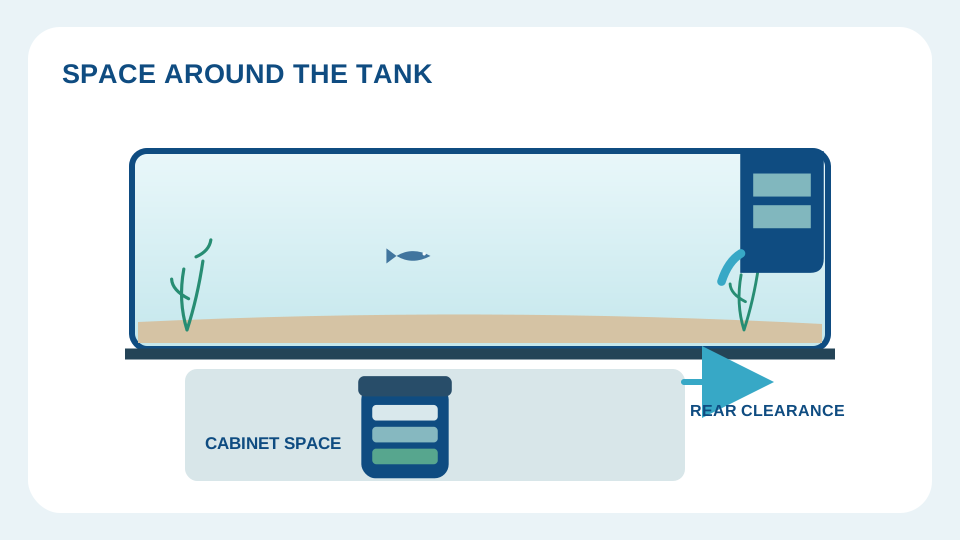
A canister needs a safe floor or cabinet position, hose routes, tank-edge openings for intake and return, and enough clearance to remove the body during service. Check the allowed height difference and hose length for the particular model. Secure connections and inspect them after setup.
A HOB needs space behind the tank, a compatible rim, lid clearance, and adequate water depth for its intake. A tank flush against a wall may not fit one. If no cabinet or floor space exists, a canister may be impractical despite its media capacity.
| Check | Canister | HOB |
|---|---|---|
| Main location | Cabinet or floor | Tank rim |
| External clearance | Hoses and service room | Wall and lid clearance |
| In-tank parts | Intake and return | Intake |
| Startup | Connect and prime as directed | Fill/prime if model requires |
Cost: Purchase and Ongoing Media
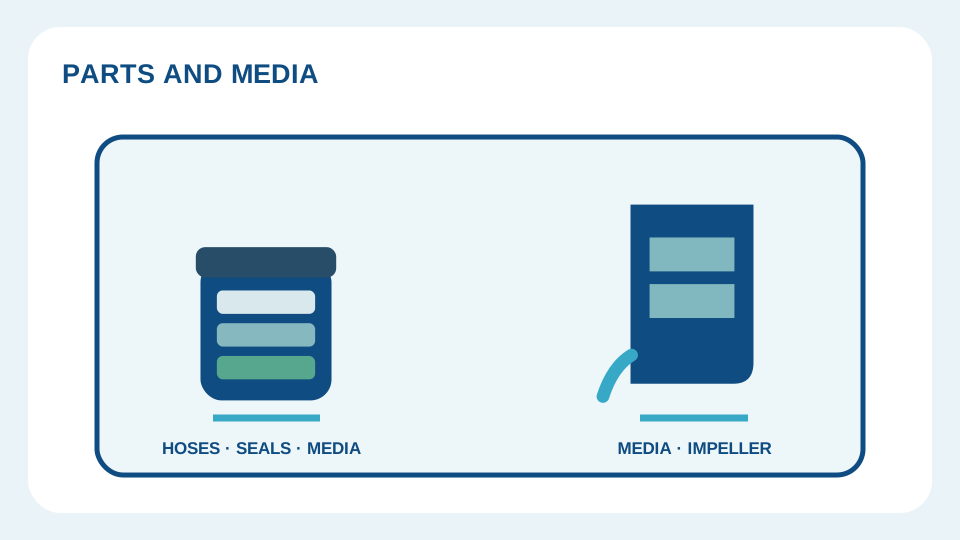
HOB filters commonly cost less initially, while canisters usually require a larger purchase. Actual prices change by model and market, so a useful comparison includes media, replacement parts, energy use, and maintenance time. Some cartridge-oriented HOB designs create ongoing replacement costs; models using reusable media can reduce them.
| Cost area | Canister | HOB |
|---|---|---|
| Initial equipment | Usually higher | Usually lower |
| Media quantity | More | Less |
| Reusable media | Widely supported | Model-dependent |
| Plumbing | Hoses, seals, valves | Minimal |
| Possible parts | Hoses, seals, impeller | Impeller, pump, intake |
Do not replace established biological media only because a generic calendar says to. Follow the media maker's directions and replace material when its function or condition calls for it.
Canister Filter Advantages and Disadvantages

Advantages
- Large media capacity on many models.
- Flexible mechanical, biological, and optional chemical stages.
- Most hardware can be hidden below the display.
- Return placement can shape circulation and surface movement.
- Useful option for greater waste loads when correctly sized and maintained.
Disadvantages
- Usually higher upfront cost and more setup steps.
- Service often takes longer; hoses and impeller need attention.
- Seals and connections must be fitted correctly to prevent leaks.
- Hidden media can conceal clogging until flow changes.
HOB Filter Advantages and Disadvantages

Advantages
- Usually straightforward to install and open.
- Media is easy to inspect during routine care.
- Initial cost is often lower.
- Many returns provide useful surface movement.
- No long external return hose is normally needed.
Disadvantages
- Many models have less media space.
- The body remains visible behind the tank and needs clearance.
- A low water level can make the return noisy.
- Some cartridge-focused models allow limited customization, though others have reusable baskets.
Which Filter Fits Different Aquariums?

Tank volume is only a starting point. Two tanks of the same size can have very different waste loads, plant cover, and current needs. A shrimp or fry tank may need a suitable pre-filter sponge over either design's intake.
| Situation | Consider |
|---|---|
| Small community tank | HOB simplicity may be enough if correctly sized |
| Medium community tank | Either; compare load, media, noise, and maintenance |
| Large tank | Canister capacity may be useful |
| Heavy stocking | Prioritize biological capacity and debris removal |
| Planted tank | Plan return placement and CO₂ strategy |
| High-waste fish | Plan mechanical care and realistic maintenance |
| Shrimp or fry | Protect intake and match current to animals |
| Display tank | Canister may hide more equipment |
| Limited rear clearance | Canister may fit if cabinet space exists |
| No cabinet space | HOB may be easier to house |
Canister Filter vs HOB: Decision Checklist
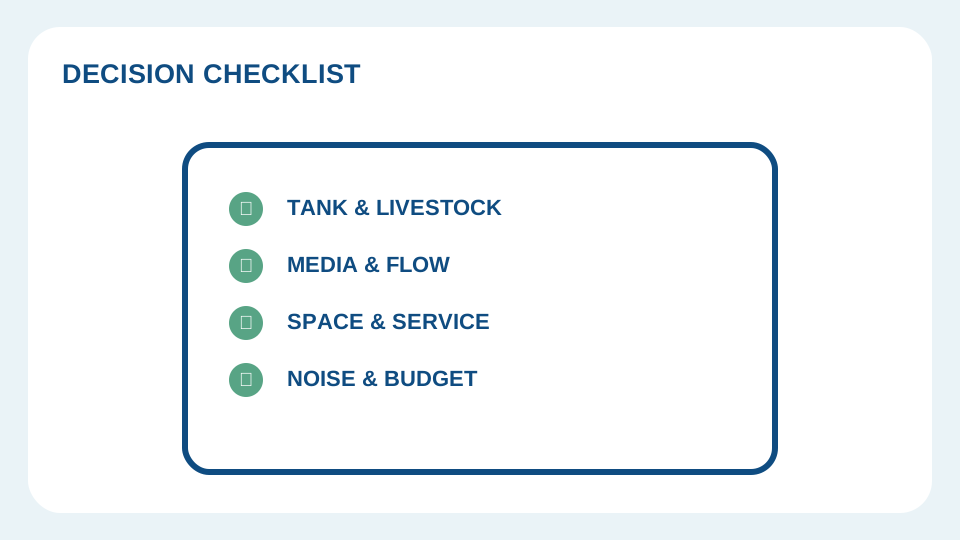
Consider a Canister When
- You need substantial or flexible media space.
- You have a safe cabinet or floor location.
- You want separate intake and return placement.
- You accept more involved service to keep hardware less visible.
Consider a HOB When
- Quick access and simpler installation matter most.
- The tank has rear and lid clearance.
- The model's media capacity suits the actual load.
- You prefer to avoid external hoses.
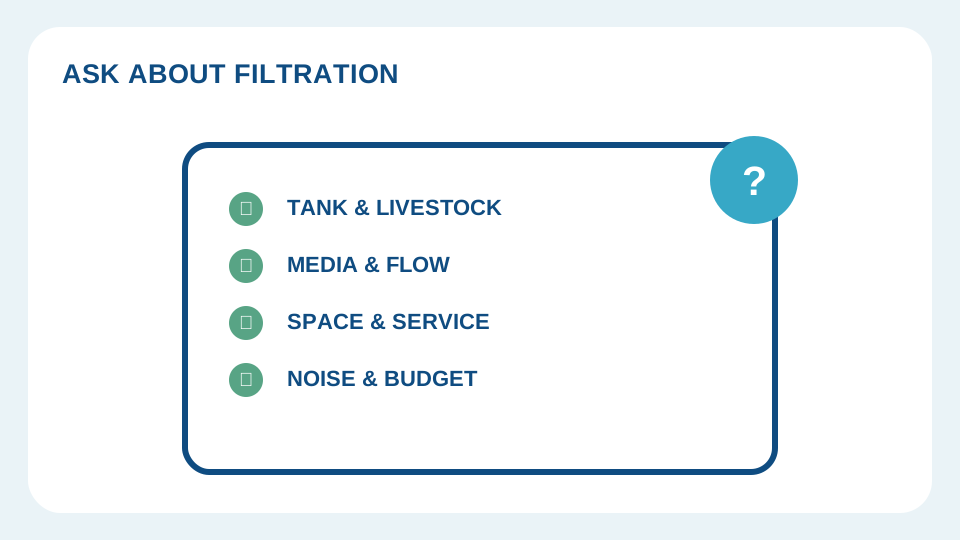
Before buying: Check tank dimensions, livestock, waste load, desired current, media space, return position, noise tolerance, service access, parts availability, and the maker's instructions. No one number settles all of these.
Common Comparison Mistakes
- Assuming a canister always produces healthier water.
- Choosing only from the tank-size label on a box.
- Comparing rated GPH without plumbing or loaded media.
- Ignoring media volume and the actual water route.
- Ignoring circulation behind hardscape or in long tanks.
- Choosing a current too strong for the livestock.
- Never cleaning hoses, intakes, or impellers.
- Replacing all established biological media at once.
- Letting mechanical media clog severely.
- Assuming every HOB needs throwaway cartridges.
- Assuming every canister is silent.
- Leaving shrimp or fry exposed to an unprotected intake.
Can You Use a Canister and HOB Together?

Yes. A second filter can add mechanical capture, extra colonized media, redundancy, or circulation in a larger tank. It may also keep mature media running while another unit is serviced or changed. Place the intakes and returns so the two systems complement the aquarium's flow rather than producing a harsh current in one area.
- Potential gain: more media and another path for water movement.
- Added work: more equipment to clean, power, and inspect.
- Decision: use observed tank needs and water-test trends, not the assumption that more filters are always better.
What About Saltwater Aquariums?

Both designs can be used in selected marine systems, but they are only part of a complete filtration plan. Marine tanks may use other circulation and nutrient-management equipment, depending on livestock and system type. Mechanical media in either filter can hold detritus; leaving it dirty can undermine a nutrient-control plan.
For a reef or specialized saltwater tank, consider the whole system's flow, gas exchange, biological capacity, and maintenance. Neither a canister nor a HOB is automatically the right standalone answer.
Frequently asked questions
Frequently Asked Questions About Canister and HOB Filters
Short answers to common selection questions.
Is a canister filter better than a HOB filter?
Neither is universally better. A canister usually offers more media space and flexible return placement, while a HOB is generally easier to access and install. Compare the actual model, tank, animals, waste load, and your willingness to service it.
Does a canister filter clean water better?
It can accommodate more media, but clean water depends on the right media, adequate flow, sensible stocking, and maintenance. A neglected canister may perform worse than a properly maintained HOB. Look at the aquarium's water-test trends and visible debris rather than treating filter size as proof.
Can a HOB filter provide biological filtration?
Yes. Beneficial microorganisms colonize reusable biological media and other wetted surfaces in an established HOB. How much biological capacity it provides depends on usable media space, flow, maintenance, and waste input. A cartridge-style design may offer fewer choices than a model with a roomy basket.
Are canister filters quieter than HOB filters?
Often the enclosed body can be placed out of sight in a cabinet, avoiding waterfall noise. Yet trapped air, impeller wear, or cabinet vibration can be audible. A HOB can also run quietly when installed correctly and when the water level is near its outlet.
Which filter is easier to maintain?
A HOB is usually quicker to open and inspect from the tank rim. A canister may require valve closure, hose disconnection, opening baskets, and re-priming. Both need condition-based care; an easy filter that is cleaned regularly may suit a keeper better than a larger one left clogged.
Are canister filters good for planted aquariums?
They can be, because separate return fittings offer options for circulation and surface movement. Planted tanks using added CO₂ still need gas exchange, so an absolutely still surface is not the goal. A well-placed HOB can also serve a planted tank if flow and media suit it.
Is a HOB filter enough for a large aquarium?
Possibly, depending on the particular HOB, stocking, waste load, and tank shape. A large tank may benefit from more media or multiple circulation points, but there is no universal gallon cutoff. Assess actual performance and maintenance access before deciding.
How often should I clean a canister or HOB filter?
Follow the maker's instructions and watch for falling flow, clogged pads, accumulated debris, or unusual noise. No single calendar interval fits every aquarium. Clean mechanical media as needed while avoiding unnecessary sterilization of established biological media.
Can I use both filters at the same time?
Yes. Running both can add media capacity, flow coverage, or backup. It also adds power use and service work. Keep the combined current appropriate for livestock and avoid doubling equipment without a clear reason.
Do HOB filters need disposable cartridges?
No. Some models are cartridge-oriented, while others support reusable foam, biological media, and customizable baskets. Check the design and the manufacturer's instructions. Replacing established media unnecessarily can reduce biological capacity.
Does more filter media always mean better filtration?
No. Water needs to move through useful media, and biological surfaces need oxygen and appropriate maintenance. The tank's bioload and feeding set the demand. A large but clogged chamber is not automatically more effective than a smaller, well-run one.
Should I choose a filter based on GPH?
Flow rating is one input, not the whole decision. Media and hoses can reduce operating flow, while tank dimensions and animal preferences determine where movement is needed. Consider circulation, filter capacity, return design, and maintenance alongside the stated GPH or LPH.

Conclusion
Canister Filter or HOB Filter: Which Makes More Sense for Your Aquarium?
A canister is a sealed external filtration system with intake and return hoses, usually offering generous media space and flexible outlet placement. A HOB sits on the aquarium rim and returns water directly, making the media easier to reach. Both can provide mechanical and biological filtration, and either can hold optional chemical media when its design permits.
The more expensive choice is not automatically the better choice. Match the filter to the tank's waste load, animals, dimensions, desired current, media requirements, and the work you can do consistently. Keep enough space for installation and service. Evaluate real operating flow rather than a box label alone.
- Tank, livestock, and bioload
- Media and circulation needs
- Surface movement and noise
- Service access, space, and budget
Choose the system you can size correctly, maintain consistently, and configure for the animals you keep.
Ask Aqualume
Need Help With Your Aquarium Filtration Project?
Tell us what you need to filter and which equipment choices you are comparing. We will reply by e-mail.
Further reading
More Aquarium Filtration Guides
 Filter media
Mechanical, Biological, and Chemical Filtration
Learn what each media type does and when a particular stage is useful.
 Gentle filtration
What Is a Sponge Filter and How Does It Work?
See how air-driven foam provides mechanical and biological filtration.
 Gas exchange
What Is Dissolved Oxygen in Aquarium Water?
Understand surface movement, oxygen demand, and aquarium circulation.