Which size fits?
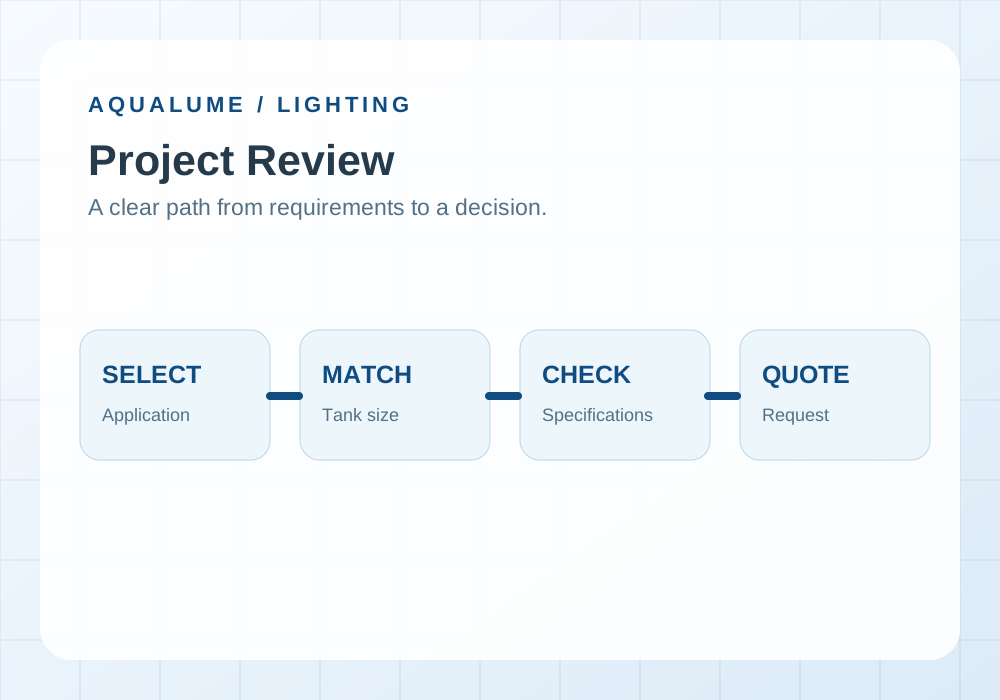
Share tank dimensions and mounting height. Check model coverage.


Aqualume / Lighting
Model details confirmed per request
LED aquarium lights illuminate freshwater, planted, nano, and fish-display tanks. Marine or reef use requires confirmation against a suitable model. This page helps importers, distributors, aquarium brands, and project buyers compare light output, spectrum, coverage, mounting, and controls. Share the tank application and purchasing requirements to discuss wholesale supply or model-specific private-label and OEM options.
Product list
These six illustrated range cards link to the relevant collection entries. Verified model identifiers and specifications are pending; share your project requirements to confirm available options.

Freshwater display
Check fixture fit, output, and mounting for the chosen tank.

Planted tanks
Compare PAR at plant depth, spectrum, and coverage.

Spectrum review
Request the model spectrum and control data before selecting a fixture.

Color control
Review channels, measured output, and application fit.

Planted display
Check white and color channels alongside plant needs.

Linear format
Confirm length, mounting position, and tank compatibility.
Technical data
Specifications vary by fixture. Confirm electrical input, dimensions, compatible tank size, light distribution, spectrum, controls, mounting, and housing for the exact model. For planted or reef applications, request PAR data with a stated distance or depth. Wattage describes power use; it does not establish coverage or usable light on its own. Do not assume a timer, app, water-resistance rating, or certification applies across every series.
Request a model sheet
| Wattage | [Model Wattage] | Input voltage | [Input Voltage] |
|---|---|---|---|
| Fixture length | [Fixture Length] | Tank fit | [Recommended Tank Size] |
| Spectrum | [Spectrum Data] | PAR output | [PAR Data] |
| Dimming | [Dimming Range] | Control method | [Control Method] |
| Mounting | [Mounting Method] | Housing | [Housing Material] |
| Water resistance | [Verified Rating] | Documents | [Available Certifications] |

Before an RFQ
Start with the tank and destination market. The answers below identify details to verify before selecting or quoting a fixture.
Share tank dimensions and mounting height. Check model coverage.
Identify the application and request actual spectrum information.
Confirm model-specific dimming and channel controls.
Check timer, controller, or app support for the exact model.
Confirm brackets, stands, and optional accessories.
State the market, voltage, frequency, plug, and documents.
Order review
Specification confirmation before production can reduce compatibility errors. Buyers should approve the reference model, electrical configuration, packaging, and required documents. Ask which sample and inspection steps apply to the order.

Match the fixture to tank size, application, and light requirements.
Confirm the current model sheet before quotation or approval.
Check availability, appearance, controls, and mounting before wider orders.
Verify voltage, plug, and power supply for the market.
Confirm carton design and protection for the selected item.
Ensure any report refers to the exact model and destination.

Model-specific options
Cosmetic requests such as logo, label, manual, or carton artwork differ from engineering changes to the light, housing, controller, or power supply. Send your target model and requirements for feasibility review. No customization option, MOQ, or schedule should be assumed across the range.
Review housing color, dimensions, and finish.
Check spectrum and output feasibility.
Ask about dimming, timers, or apps.
Check brackets, stands, and installation.
Specify voltage, supply, and plug.
Provide logo, label, manual, and carton artwork.
Confirm the applicable [MOQ] and any sample terms for the selected scope.
Project stages
Provide tank application, target market, dimensions, spectrum and control needs, branding artwork, quantity, and compliance requirements. Confirm sample and production timing for the agreed scope.
Share application, quantity, market, and requested changes.
Confirm dimensions, light data, controls, and electrical fit.
Check availability and the agreed evaluation scope.
Review agreed evidence and approve the reference item.
Plan work against the approved specification.
Check agreed functions, appearance, and packaging.
Confirm cartons, documents, and dispatch details.
Product verification
Check which tests and inspections apply to the chosen model. Electrical safety, power supply behavior, LED function, controls, thermal performance, and housing condition affect product suitability. Request records when the project requires evidence; confirm the manufacturer, test conditions, and model identifiers before relying on a result.


Tank applications
Choose the light around the aquarium’s purpose, dimensions, depth, and required control. Marine and reef suitability must be confirmed per model.
Check viewing light, coverage, and tank fit.
Review PAR at plant depth, spectrum, and control.
Balance plant needs with color rendering and even spread.
Check compact mounting and reduced coverage area.
Request a model confirmed for the relevant light requirements.
Compare mounting access and consistency across tanks.

Product definition
LED aquarium lights are fixtures designed to illuminate aquariums. Depending on the model’s spectrum and output, they may also serve the light needs of aquatic plants or photosynthetic reef organisms. Spectrum describes the wavelengths delivered; PAR describes usable radiation for photosynthesis at a stated measurement point. Tank depth and mounting height affect light reaching lower areas, while fixture coverage affects uniformity. Dimming and scheduling control intensity and photoperiod when supported. Lumens alone do not establish suitability for a planted or reef tank.
Check the actual wavelength distribution.
Review measurement depth and position.
Match the tank footprint.

Category comparison
Compare product families by application, tank depth, spectrum, output evidence, controls, and mounting. The table gives a buying framework; it does not assign one specification to every model.
Swipe sideways to see all comparison columns.
| Range | Typical application | Check first | Control review |
|---|---|---|---|
| General LED | Freshwater display | Tank fit, output | On/off or dimming |
| Planted LED | Aquatic plants | PAR, spectrum, coverage | Intensity control |
| RGB / WRGB | Color-led display | Channels, measured output | Channel options |
| Light bar | Linear placement | Length, mounting, spread | Model-dependent |
| Marine / reef request | Only if model verified | Depth, PAR, spectrum | Model-dependent |
RFQ checklist
A precise request reduces model mismatches and incomplete quotations. Group the following information before asking for a specification sheet, sample, or price.


Business buyers
When evaluating Aqualume as a supplier, aquarium brands, importers, distributors, and retailers can start with a range enquiry, then confirm exact models and supply terms. Private-label artwork, packaging, market-specific electrical fit, and product documentation should be reviewed for each order. Replacement parts or repeat-order requirements belong in the initial brief.
See Aqualume company information, browse the lighting collection, or send a project request below. Any exclusive specification or development scope requires a separate agreement.

Buyer questions
Short answers for comparing models and preparing a sourcing request.
Send tank dimensions, aquarium type, livestock or plant needs, preferred controls, destination-market electrical requirements, and estimated quantity. These details help narrow the model review.
PAR describes photosynthetically active radiation. Model-specific measurements at a stated distance or depth help compare usable light for planted or reef applications.
Suitability depends on spectrum, PAR at plant level, coverage, tank depth, and plant requirements. Check those factors against data for the specific fixture.
Send the model and requested appearance, light, control, mounting, electrical, or branding changes. Engineering options require a feasibility review; private-label options also vary by item.
The listed ranges include freshwater and planted applications. For reef or marine projects, request confirmation of a suitable model and relevant performance data before selection.
Use the form below with the range, application, estimated quantity, market, electrical needs, and customization requests. Ask for sample availability and terms for the chosen model.

Project enquiry
Tell us the lighting range, tank application, target market, estimated quantity, and technical or branding requirements. We will review the request against available model information and confirm the next details to check.