
How the system works
How Does Water Move Through an Aquarium Filter?

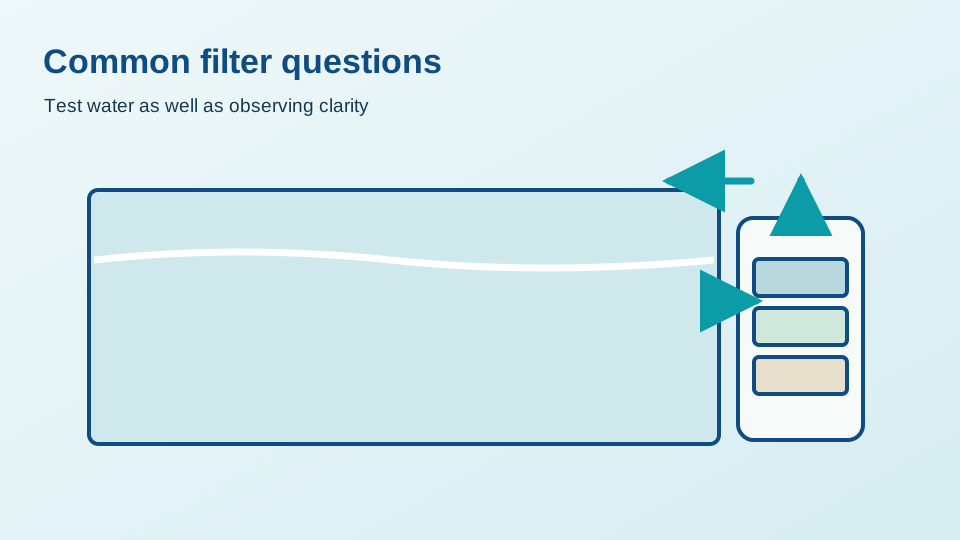
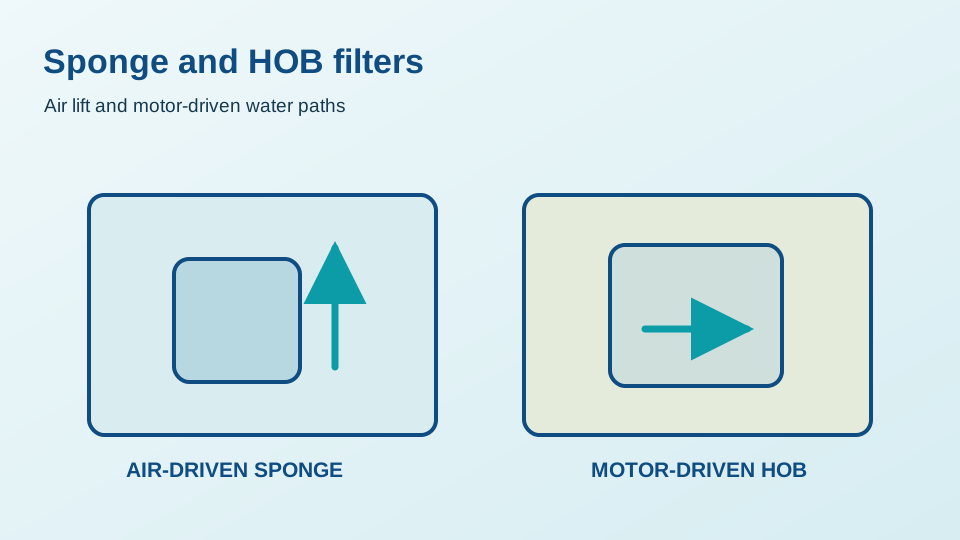
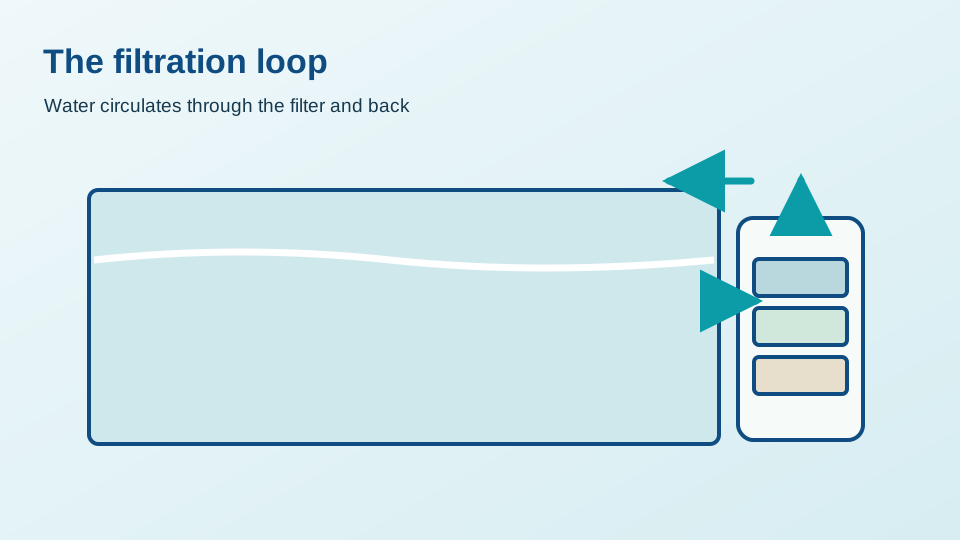
Water movement starts at the intake. In a motor-driven filter, an impeller creates the flow that pulls water into the unit or pushes it through media. In a sponge filter, rising air bubbles in an uplift tube move water upward, drawing more water through the sponge wall. Both designs repeatedly deliver tank water to a useful surface.
The Filtration Cycle in 5 Steps
- Water enters: an intake, inlet chamber, or sponge receives aquarium water.
- Debris is trapped: porous media intercepts suspended solids.
- Water contacts biological surfaces: dissolved nitrogen waste reaches established microorganisms.
- Optional media acts: a suitable chemical medium targets a dissolved compound.
- Water returns: an outlet or uplift tube circulates water back into the tank.
Useful contact depends on water passing through rather than around the media. A badly seated cartridge may allow bypass; a clogged pad may reduce flow. Packing a chamber tightly can also make a pump work against resistance. Observe the outlet after service to confirm that water still moves as intended.
A filter cannot catch debris that stays settled behind rocks or deep in gravel. Nor does it destroy the solids it captures. The trapped material can keep decomposing until a keeper rinses or replaces the loaded mechanical stage. Regular tank cleaning therefore complements the filter.
Flow is continuous in normal operation because the biological community depends on delivery of oxygenated water and dissolved waste. In many designs, one medium performs more than one job: foam physically strains particles while its wet internal surfaces also support microbial growth.
The Three Types of Aquarium Filtration

| Type | Primary job | Common media | Target |
|---|---|---|---|
| Mechanical | Physical capture | Sponge, foam, floss | Food, waste, fragments, suspended particles |
| Biological | Microbial processing | Sponge, ceramic, porous media | Ammonia and nitrite through nitrification |
| Chemical | Targeted removal | Carbon, specialty resins | Selected dissolved substances |
Mechanical Filtration
Mechanical media works like a physical strainer. A coarse sponge intercepts leaves, food fragments, and larger waste while staying open relatively long. Finer foam or filter floss catches smaller suspended particles and can polish visible haze, but generally fills more quickly. Filter socks in suitable sump systems perform a similar capture job.
- Coarse sponge or foam: larger debris and pre-filtration.
- Fine sponge or floss: smaller particles and polishing.
- Filter pad or sock: removable collection of solids.
Media loaded with debris must be cleaned or replaced as directed. If flow weakens, the filter may deliver less oxygenated water to later stages. Catching solids helps clarity, but mechanical filtration alone does not make dissolved ammonia or nitrite safe.
Biological Filtration
Biological filtration is the long-term foundation of most stocked aquariums. Beneficial microorganisms colonize wet, oxygenated surfaces and transform dissolved nitrogen compounds from waste. Porous ceramic, sponge, sintered glass, and other media provide additional area, while steady filter flow brings oxygen and dissolved ammonia and nitrite to those surfaces.
Biological Filtration Needs
- An established microbial community.
- Oxygenated water and continuing circulation.
- Accessible surface area rather than media choked with debris.
- Careful maintenance that preserves mature media.
Microorganisms also live on substrate, plants, decorations, and glass. The filter is especially useful because it moves water over its media continuously. The bacteria do not simply eat whole fish waste: organic material breaks down and releases dissolved compounds, then nitrifying organisms participate in converting ammonia and nitrite.
A new ceramic ring or sponge offers surface area but is not instantly mature. Colony development takes time and depends on suitable conditions. Replacing all established material together may sharply reduce the system's biological capacity, even when a brand-new cartridge looks cleaner.
Chemical Filtration
Chemical media addresses a defined dissolved target. Activated carbon can adsorb many organic compounds, unwanted discoloration, and remaining medication after treatment when appropriate. Specialty resins and other products address their own specified substances. Their usefulness depends on the actual problem, tank type, water contact, and remaining media capacity.
- Use carbon or a suitable resin for a supported organic-water-quality goal.
- Follow treatment instructions about removing carbon while medicating.
- Replace or regenerate media according to its manufacturer's directions.
- Continue testing and correcting the source of a recurring problem.
Chemical filtration is not mandatory in every aquarium. It does not replace a mature biological filter or water changes. Standard carbon should not be treated as a reliable ammonia or nitrite remedy. Place a chemical bag where actual water flow contacts it without displacing essential biological media.
Biological Filtration and the Aquarium Nitrogen Cycle

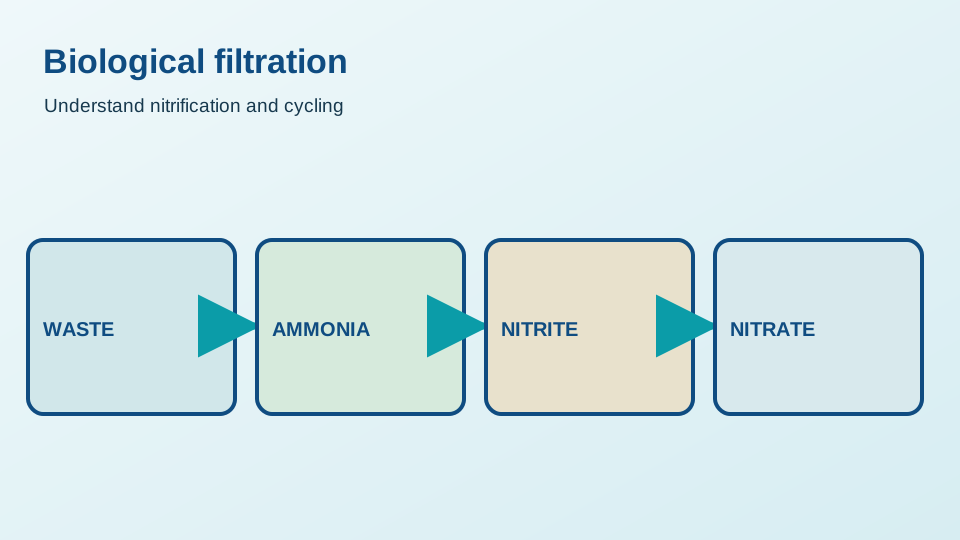
Fish release waste, and uneaten food and other organic matter break down. This adds ammonia to the system. Nitrifying microorganisms oxidize ammonia into nitrite; other nitrifying organisms convert nitrite into nitrate. Both ammonia and nitrite can be dangerous to aquatic animals. Nitrate is generally less acutely toxic, but accumulation still needs management.
Nitrogen path: fish waste and decomposing matter → ammonia → nitrite → nitrate.
Biological media does not remove all nitrogen from the aquarium. It mainly changes more hazardous compounds into nitrate under suitable oxygenated conditions. Appropriate partial water changes, plant uptake where relevant, and control of feeding and stocking help manage nitrate. Water tests reveal these compounds far more reliably than appearance.
Important Beginner Mistake
Clear water does not automatically mean safe water. A newly installed filter can strain particles from day one while lacking enough nitrifiers to handle ammonia and nitrite. Cycling means establishing that microbial processing capacity. It commonly takes weeks, but testing matters more than a fixed number of days.
Signs Biological Filtration May Be Disrupted
- Detectable ammonia or nitrite in an established aquarium.
- Recent wholesale replacement of mature filter media.
- A long interruption of water movement or oxygen supply.
- Biological media left to dry during maintenance.
- A sudden substantial increase in livestock or feeding.
One test result should be interpreted alongside tank history and animal behavior. If ammonia or nitrite appears, protect livestock and find the cause. Adding fresh carbon does not turn a new filter into a mature biofilter.
How Different Aquarium Filter Types Work

The same filtration functions can appear in different hardware. The key difference is how water enters, crosses media, and returns. Knowing that route helps you maintain the unit and avoid assuming every basket or cartridge serves the same purpose.
| Filter | Water movement | Main strengths | Common use |
|---|---|---|---|
| Sponge | Air lift draws water through foam | Mechanical and biological | Breeding and gentle-flow tanks |
| Hang-on-back | Motor pulls water through chamber | Multiple media types | General freshwater tanks |
| Canister | Pump moves water through sealed external body | Substantial, flexible media volume | Larger or media-heavy setups |
| Internal | Submerged pump and chamber | Compact mechanical and biological stages | Smaller or space-limited setups |
| Undergravel | Water passes through substrate and plate | Large colonizable substrate area | Traditional layouts |
| Sump or wet-dry | Drain to chambers; pump returns water | Customizable stages and volume | Larger systems |
Sponge Filters
An external air pump sends bubbles up an uplift tube. Rising air moves water upward, drawing surrounding water through sponge walls. The foam traps some debris and provides microbial surface. Flow is generally gentle, which can suit fry, shrimp, and calm-water setups.
Hang-on-Back Filters
An intake tube leads tank water to a motor and media chamber hanging on the rim. After passing through a cartridge or other inserts, water returns over a lip or outlet. Media combinations vary by model; trace the path before changing them.
Canister Filters
Hoses connect the aquarium to a sealed external vessel. A pump drives water through baskets or chambers that can hold coarse capture, biological media, and optional specialty material. Their larger media volume is useful only if the intake, impeller, and loaded media still allow adequate flow.
Internal Power Filters
The pump and filter chamber stay submerged. Water enters the housing, crosses its media, and exits through a directional outlet. The same mechanical and biological principles apply, though compact chambers may need frequent inspection under a heavy debris load.
Undergravel Filters
Water is pulled through the gravel bed and a perforated plate by an air lift or powerhead. Substrate offers broad colonizable area and catches some material. Accumulated debris still needs substrate care; the plate does not make waste vanish beneath the gravel.
Sumps and Wet-Dry Systems
Water drains from the display to separate chambers, meets mechanical and biological stages, and is pumped back. Wet-dry designs expose media to both water and air, supporting oxygen availability. Their layout can be customized, but the actual water route still governs media placement.
How Aquarium Filter Media Should Work Together

Follow the actual direction of water flow through your specific filter. “Top basket first” is not a universal instruction. A canister, HOB, internal unit, and sump can route water differently, and some have parallel paths or combined cartridges. Use the manufacturer's diagram or inspect the equipment before rearranging it.
| Stage | Main purpose | Maintenance priority |
|---|---|---|
| Coarse mechanical | Catch larger solids | Rinse when loaded or flow falls |
| Fine mechanical | Polish smaller particles | Clean or replace as needed |
| Biological | Support microbial community | Keep wet; avoid unnecessary replacement |
| Chemical | Target a selected dissolved compound | Replace or regenerate per product directions |
Coarse capture before finer material can keep fine pads open longer. Removing excess solids before water reaches biological media may prevent clogging of its surfaces. Optional chemical media should receive reasonably particle-free water and enough contact without blocking circulation.
This is a functional principle, not a mandatory basket stack. An air-driven sponge combines mechanical and biological jobs in one body. A cartridge may mix fiber and carbon. Preserve the biological role if replacing a combination insert, and make changes one stage at a time when practical.
Aquarium Filter Flow Rate, Turnover, and Capacity
An advertised pump-flow rating is usually measured under specified conditions. Real flow can be lower after hoses, bends, lift height, media, and accumulated debris add resistance. Watch the actual return and the aquarium's circulation rather than relying only on the number on a box.
Flow rate and biological capacity are related, but they are not the same measurement. A fast pump through too little established media may not provide enough microbial surface. A large media chamber with poor water delivery also underperforms. Consider contact, oxygen, microbial maturity, and the waste produced by the tank.
Choose flow in context
- Tank volume and shape.
- Number, size, and waste production of livestock.
- Species preferences for current; bettas and fry often need gentler movement.
- Plant growth, hardscape, and areas of weak circulation.
- Media capacity and the maker's suitable tank range.
- How much flow falls between maintenance sessions.
More current is not automatically better for fish. Some animals need vigorous water movement; others struggle against it. A return that disturbs the surface can help gas exchange, but a strong jet aimed at a calm-water species can create stress. Adjust outlet direction or choose a gentler configuration while retaining adequate filtration capacity.
There is no single turnover number that settles every aquarium decision. Use the filter maker's guidance as a starting point, then observe fish behavior, waste accumulation, surface movement, and test results. If output declines, inspect the intake, media, hoses, and impeller before deciding the pump is undersized.
For example, a planted aquarium with dense hardscape may need its return aimed to move water behind the layout, while a breeding tank may need the same biological stability with much less current around fry. A stronger pump cannot correct a blocked intake or an uncycled filter. Check where water actually travels, then adjust direction, media, or maintenance to solve the observed problem.
How to Clean a Filter Without Damaging Biological Filtration
Maintenance removes captured waste and restores flow while protecting the established microbial community. How often it is needed depends on feeding, stocking, filter size, media density, visible debris, and flow decline. A calendar reminder to inspect is useful; a universal clean-every-X-days rule is not.
Basic Maintenance Checklist
- Unplug electrical equipment as appropriate and follow its service instructions.
- Check the intake, outlet, and observed flow.
- Remove debris from mechanical sponge, floss, or pads.
- Keep biological media wet while the filter is open.
- Gently rinse biological media in removed tank water or suitable dechlorinated water when needed.
- Never use soap or household detergent on aquarium media.
- Avoid replacing all established biological material together without a specific reason.
- Replace or regenerate chemical media only as instructed.
- Inspect the impeller, tubing, and return path for buildup.
- Restart the filter and verify normal water flow.
What Should You Replace?
- Mechanical sponge: usually rinse and reuse while structurally sound.
- Fine disposable media: replace when too loaded to clean effectively or when directed.
- Biological media: preserve mature material whenever possible.
- Chemical media: replace or regenerate after capacity is spent, per its instructions.
Cleaning a sponge does not require making it look new. Rinse enough to release accumulated debris and restore water movement. If one cartridge carries both mechanical and biological functions, changing it can remove more than just dirt. Consider how the filter retains an established biological surface during a replacement.
After service, check for leaks on external filters and confirm the pump has restarted correctly. Continue partial water changes and water testing as appropriate. Filter maintenance supports those practices; it does not replace them.
If a filter has been off for an extended period, do not assume its biological performance is unchanged simply because the motor restarts. Check water movement and test ammonia and nitrite over the following days, especially in a heavily stocked tank. Keep a brief maintenance note so you can connect a change in readings with cleaned media, replaced parts, or interrupted power.
Common Filter Mistakes and Troubleshooting

A visible symptom rarely identifies one cause by itself. Follow the water route, check the mechanical parts, and compare water tests with recent changes. This helps separate a pump problem from an immature biological filter or a debris source inside the aquarium.
| Problem | Possible cause | What to check |
|---|---|---|
| Weak flow | Clogged media, intake, or impeller | Sponge, floss, intake, tubing |
| Cloudy water | Particles, bloom, algae, excess feeding | Tests, media, maintenance history |
| Ammonia or nitrite | Immature or disrupted biofilter | Cycle, recent media changes, bioload |
| Sudden noise | Low water, trapped air, impeller debris | Water level, chamber, obstruction |
| Debris returns | Bypass or overloaded media | Pad seating and true flow path |
| Persistent odor | Organic buildup or specific water issue | Substrate, media, tests, source |
Avoid These Mistakes
- Replacing every mature insert at once or assuming fresh media is already cycled.
- Letting biological media dry during cleaning.
- Using soap or detergent on aquarium equipment.
- Ignoring declining flow or water bypass around pads.
- Expecting activated carbon to solve every problem.
- Overfeeding and asking the filter to compensate indefinitely.
- Assuming clear water proves ammonia and nitrite are zero.
- Skipping water changes because the filter runs continuously.
If the filter stops unexpectedly, check power and follow the manufacturer's safe restart instructions. If fish show distress, assess temperature, oxygenation, ammonia, and nitrite promptly. A clean-looking aquarium may still have a biological water-quality problem.
The questions below address the practical decisions that remain after you understand the water path and each media role.