Aquarium filtration guide
Mechanical, Biological, and Chemical Filtration in Aquariums Explained
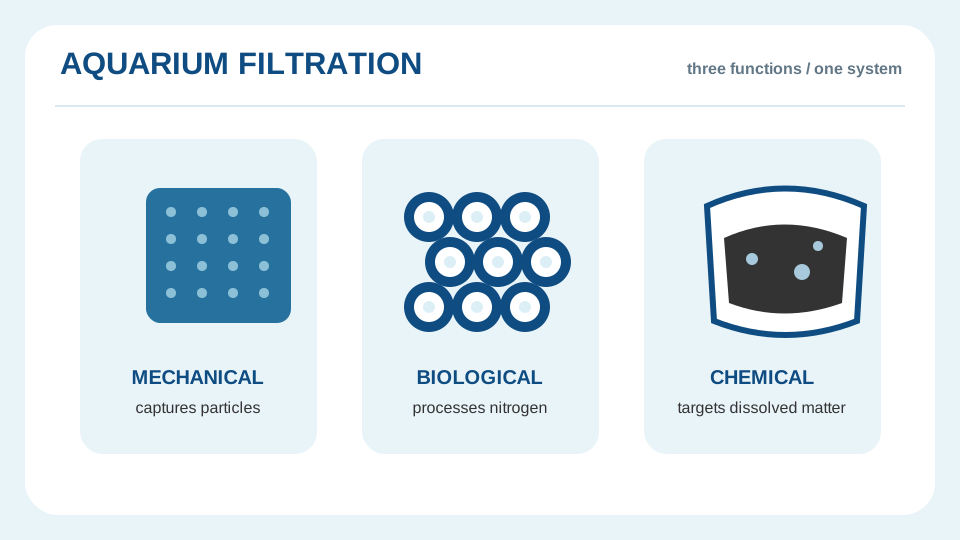
Aquarium filtration is more than one process. The filter moves water, but the materials inside it do different jobs: one catches suspended debris, another supports microorganisms that process nitrogen waste, and a third can target selected dissolved substances. Clear water alone does not show whether ammonia or nitrite is under control. Understanding each job helps you choose useful media, arrange it along the actual water path, and clean it without unnecessarily disturbing an established tank. This guide focuses on what the three stages accomplish, when they are needed, and where common maintenance advice needs more context.
At a glance
Quick Reference
| Filtration Type | Primary Job | Typical Media | What It Mainly Targets | Routine Attention |
|---|---|---|---|---|
| Mechanical | Physically traps suspended solids | Foam, sponge, floss, pads | Waste, food, plant debris, particles | Clean when loaded or flow declines |
| Biological | Supports nitrifying microorganisms | Sponge, ceramic rings, porous biomedia | Ammonia and nitrite conversion | Protect established media; clean gently as needed |
| Chemical | Targets selected dissolved compounds | Carbon, resins, specialized media | Specific organics, discoloration, residues or nutrients | Replace or regenerate for the product and purpose |
In one sentence: Mechanical filtration makes water visibly cleaner, biological filtration helps make the aquarium biologically safer, and chemical filtration provides targeted treatment for selected dissolved substances.
Overview
How Aquarium Filtration Actually Works
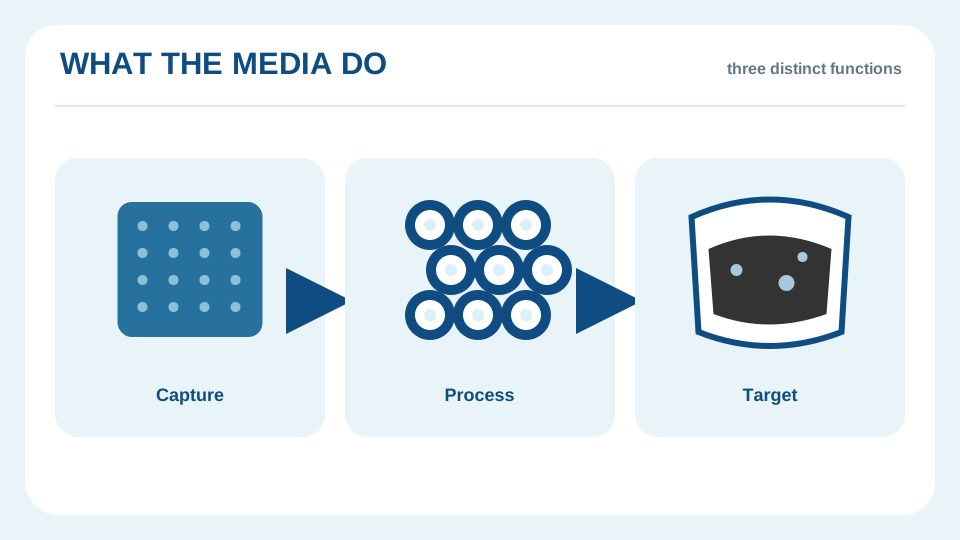
A pump draws water through a filter and returns it to the tank. The filter housing determines the route and holds media where water can contact it. The media, rather than the box itself, does the physical capture, provides living surfaces, or binds a chosen dissolved compound. One sponge can do more than one job: it strains particles and also hosts a mature microbial community.
Water clarity is useful to observe, but it is not a biological safety test. A clear aquarium can still contain harmful ammonia or nitrite; a tank with strong biological processing may still have floating particles that need mechanical capture. Chemical media addresses selected dissolved substances rather than every visible or invisible problem. The three jobs overlap in practice without becoming interchangeable.
Three different jobs, one filtration system
- Mechanical: capture particles before they circulate or settle.
- Biological: process ammonia and nitrite through an established microbial community.
- Chemical: target a selected dissolved substance with suitable media.
What filtration does not replace
- Proper cycling before adding a full livestock load.
- Water testing when conditions change or a problem is suspected.
- Water changes and removal of accumulated waste.
- Sensible feeding and stocking.
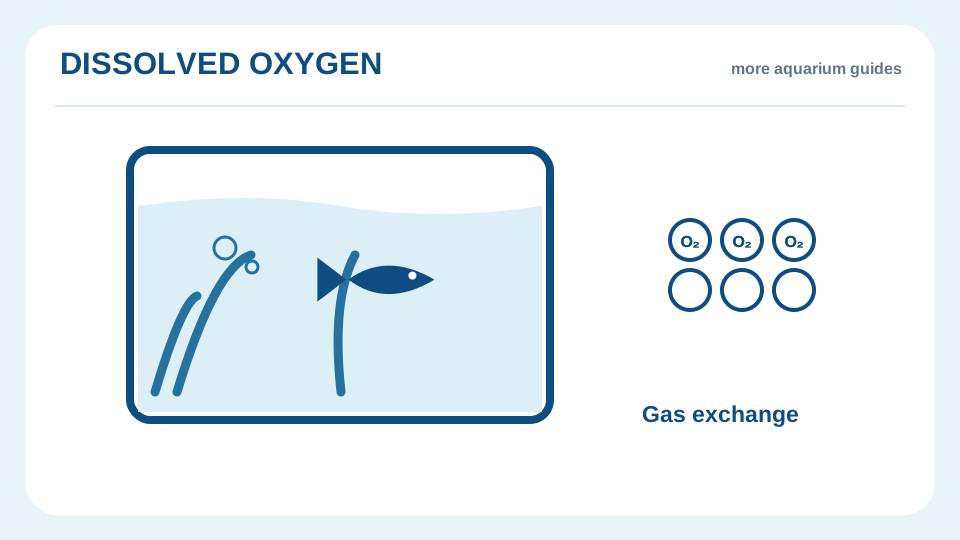
- Adequate oxygenation and water movement.
Mechanical Filtration: Removing What You Can See
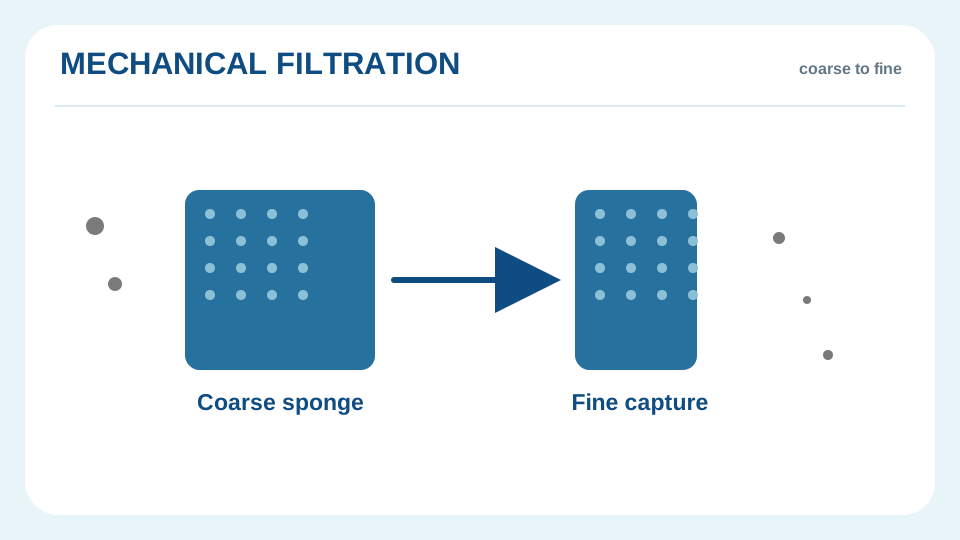
Mechanical filtration is a physical barrier. As water passes through foam, sponge, floss or a pad, particles larger than the openings become trapped. Fish waste, food fragments, loose leaves, detritus and stirred-up sand are common examples. This is the stage that most directly improves the look of cloudy, particle-filled water.
Coarse media catches larger material while allowing water through for longer. A medium sponge removes smaller debris; fine floss or polishing pads can catch the tiny particles that remain. That finer finish has a cost: dense material normally loads faster and may restrict flow or force water around it. Choose the density for the tank's debris load and the filter's available flow rather than assuming the finest pad is always best.
| Mechanical Media | Best Use | Particle Handling | Maintenance Consideration |
|---|---|---|---|
| Coarse sponge | First debris capture | Larger solids | Rinse when loaded; usually reusable |
| Medium or fine sponge | Secondary capture | Smaller solids | Watch flow; rinse gently if mature |
| Filter floss | Water polishing | Fine suspended particles | Replace when clogged or spent |
| Polishing pad | Short-term fine capture | Very fine visible haze | Loads quickly in dirty water |
| Filter sock | Sump inflow capture | Particles at the inlet | Remove and clean before waste accumulates |
Captured debris remains inside the system until you remove it. Leaving a dirty pad to decompose does not make the waste disappear; dissolved byproducts can still enter the water. Mechanical filtration also cannot strain out dissolved ammonia. Clean or replace the appropriate mechanical layer when its condition calls for it, while taking care if the same sponge carries established biofilm.
Signs your mechanical media needs attention
- Water flow falls compared with the filter's usual output.
- Waste visibly fills the sponge, sock, floss or pad.
- Water bypasses a clogged layer.
- Fine pads become unusually dirty and water loses clarity.
Biological Filtration: The Foundation of a Stable Aquarium
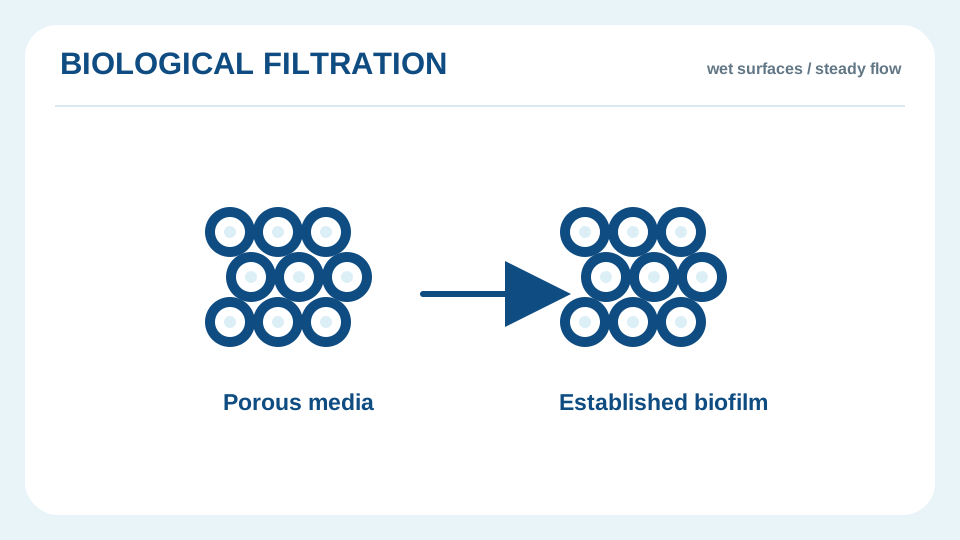
Biological filtration is the activity of microorganisms living on wet surfaces, not a sieve catching dirt. A mature community forms a thin biofilm and processes nitrogenous waste as water brings ammonia, nitrite and oxygen to it. The purpose of biomedia is to offer surfaces that remain wet and receive steady flow. Buying more ceramic rings does not instantly create a cycled aquarium.
Reusable sponge supports both mechanical and biological work. Ceramic rings, porous ceramics, sintered materials and bio-balls offer additional colonization area. Microorganisms also grow on substrate, décor, glass and other wetted surfaces; they are not confined to the filter. Filters are especially useful because they bring oxygenated water past a large amount of usable area continuously.
What effective biological media needs
- Consistent contact with circulating aquarium water.
- Oxygen for the aerobic nitrification pathway.
- Accessible surface area, rather than blocked pores or bypassed baskets.
- Stable conditions while the aquarium cycles and matures.
- Continuous operation and protection from unnecessary aggressive cleaning.
How Biological Filtration Fits Into the Nitrogen Cycle
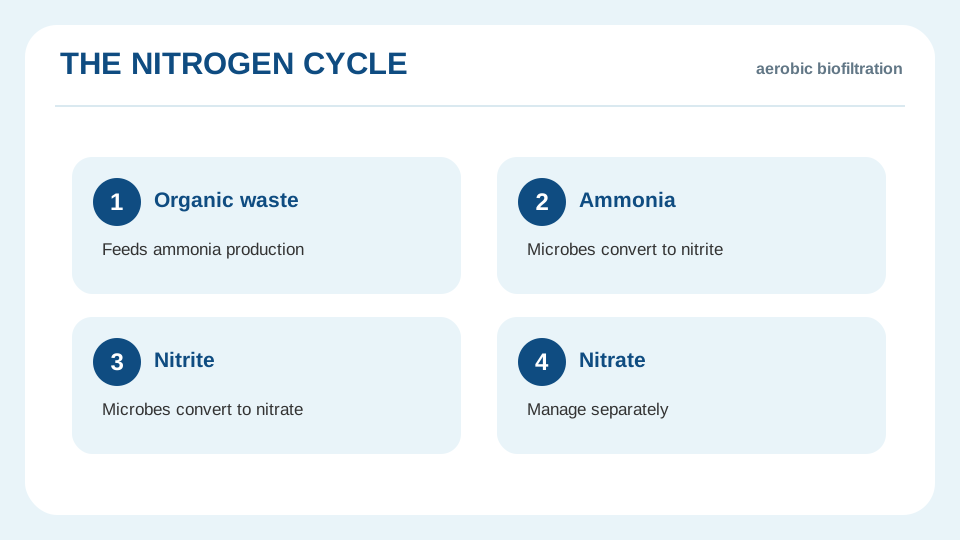
Fish release nitrogen waste, and uneaten food or other organic matter breaks down. The resulting ammonia is processed by ammonia-oxidizing microorganisms into nitrite; nitrite-oxidizing microorganisms then convert nitrite into nitrate. In shorthand: organic waste → ammonia → nitrite → nitrate. The first two compounds can be dangerous at concentrations relevant to aquarium care, so a newly cycled or disrupted tank needs careful testing.
| Compound | Where It Comes From | Role of Biological Filtration | What to Understand |
|---|---|---|---|
| Ammonia | Fish excretion and decomposing organics | First nitrification stage converts it to nitrite | Monitor during cycling and after disruptions |
| Nitrite | Ammonia oxidation | Second stage converts it to nitrate | Can rise after an ammonia spike |
| Nitrate | Nitrite oxidation | Normal aerobic media usually produce, not remove, it | Manage according to the tank and livestock |
Nitrate is generally less acutely toxic than ammonia or nitrite at typical aquarium concentrations, but it is not irrelevant. Water changes, plant uptake and, in some systems, specialized nutrient removal or denitrification can help manage it. Freshwater, densely planted, sensitive-species and marine or reef tanks may have different targets. Avoid treating a single nitrate number as universal.
Common misconception: Standard aerobic biofiltration converts ammonia and nitrite. It does not automatically make nitrate disappear, and it does not replace monitoring or water changes.
Chemical Filtration: Targeting Dissolved Substances
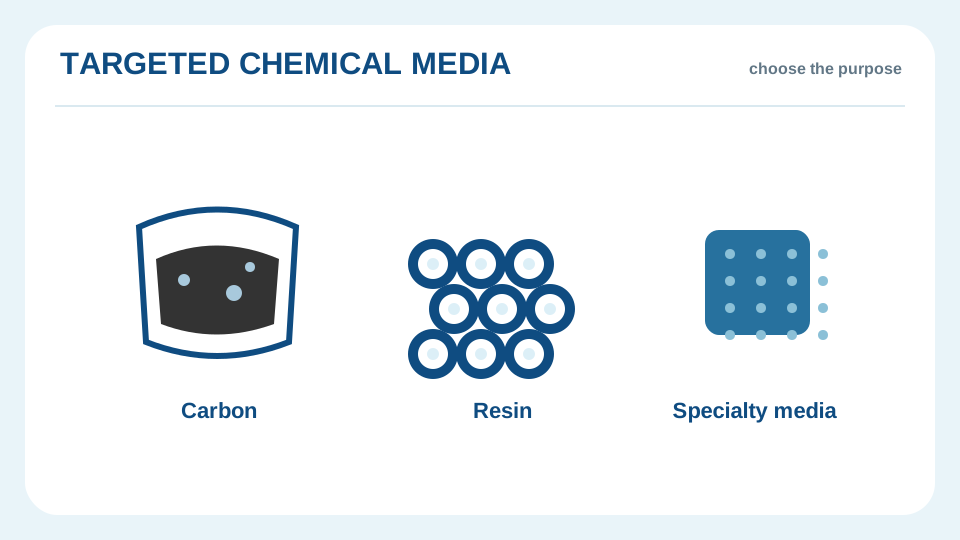
Chemical filtration addresses selected dissolved compounds that a sponge cannot simply strain out. Activated carbon adsorbs some substances onto its surface; other media bind, exchange or remove a particular substance by a different process. The word chemical describes the method, not a single universal cartridge. Chemical filtration is usually goal-dependent, so first name the compound or effect you are trying to change.
| Chemical Media | Typical Purpose | When It May Be Useful | Important Limitation |
|---|---|---|---|
| Activated carbon | Adsorb certain dissolved organics | Discoloration, odor, selected residues after treatment | Not a universal ammonia or nitrate fix |
| Adsorption resin | Bind selected dissolved substances | When the product matches a defined concern | Capacity and regeneration vary |
| Ion-exchange media | Exchange specific dissolved ions | Measured, product-specific use | Verify water-chemistry side effects |
| Phosphate-removal media | Reduce phosphate | When a measured phosphate goal warrants it | Unnecessary removal may be undesirable |
Carbon may reduce yellowing, some odors or medication residues after treatment when its instructions permit it. It does not remove every contaminant or replace biological filtration. Planted aquariums may need available nutrients, so removing every dissolved nutrient can work against the system.
Situations where chemical media may make sense
- Reducing a persistent dissolved discoloration.
- Addressing certain organics or selected medication residues after treatment.
- Managing a measured compound with media designed for that compound.
- Polishing water for a defined, observable reason.
When not to add chemical media blindly
- An empty basket alone is not a reason to fill it.
- First confirm whether the problem is particulate, biological or dissolved.
- Check product instructions, compatibility and the intended endpoint.
Chemical media can become exhausted. Replace or regenerate it according to the specific product and why it is in use; do not assume a saturated pouch remains effective indefinitely or that all products follow the same schedule.
How Mechanical, Biological, and Chemical Filtration Work Together
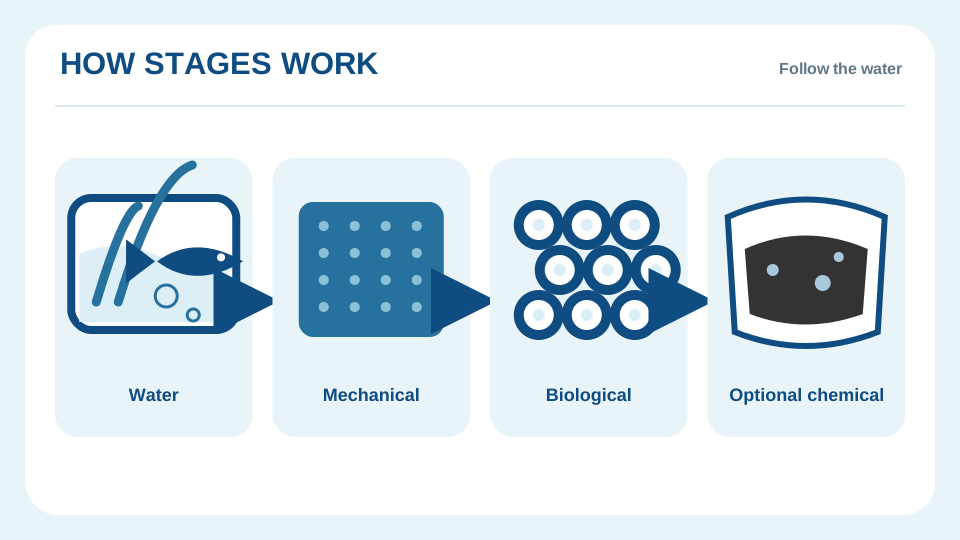
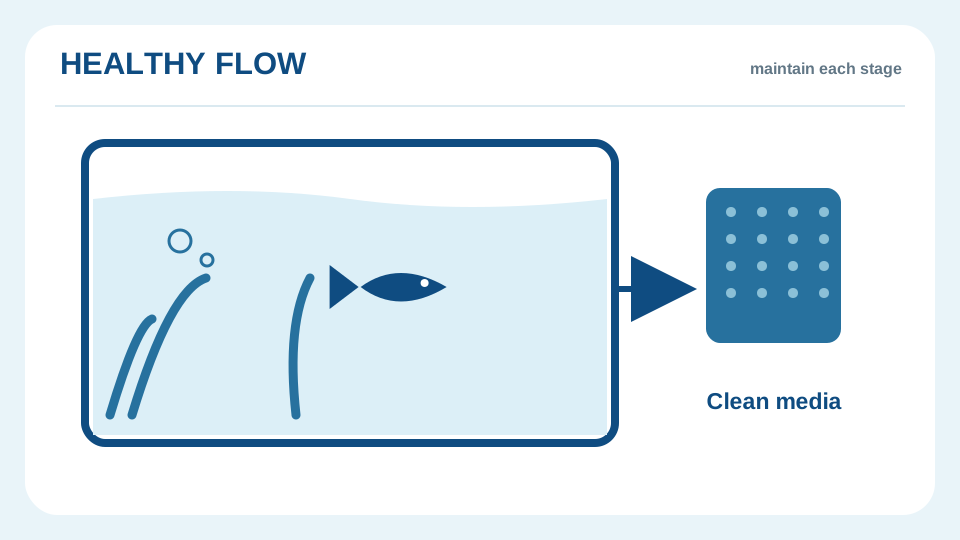
Think in functions along the path that the water actually takes. Intercepting larger solids early can keep downstream surfaces from loading with debris. Established biofilm then receives moving, oxygenated water. A chemical stage, if needed, contacts the remaining water for a specified purpose.
- Water carrying suspended debris enters the filter.
- Mechanical media catches much of the solid waste.
- Water moves across established biological surfaces.
- Microorganisms convert ammonia to nitrite and nitrite to nitrate.
- Optional chemical media targets a defined dissolved substance.
- Water returns to the aquarium and the cycle continues.
Important: Follow the water, not simply the vertical position of the basket.
What Order Should Aquarium Filter Media Go In?
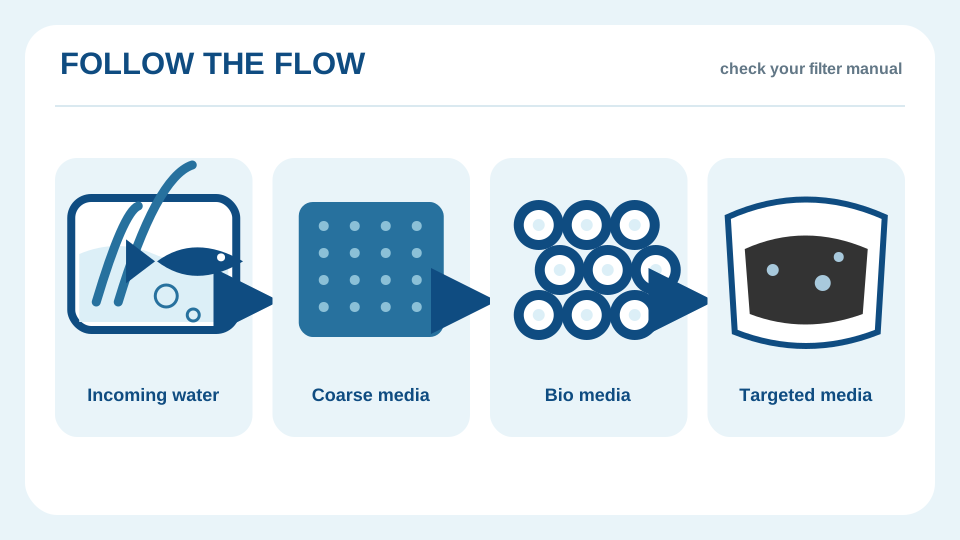
As a general principle, place coarse mechanical capture early along the incoming water path. It protects finer pads and biomedia from unnecessary solids. Biological media then gets a cleaner, moving supply; purpose-specific chemical media can follow when the product and housing allow it. Actual water-flow direction matters more than whether a basket appears to be at the top or bottom.
| Filter Type | How Media May Be Arranged | What to Check First |
|---|---|---|
| Hang-on-back | Intake to chamber, cartridge or separate media, then spillway | Where water enters and whether it bypasses a pad |
| Canister | Baskets may receive water from above or below | Manufacturer flow diagram and basket order |
| Sponge filter | Water passes through sponge before rising in lift tube | Whether the sponge remains open and flowing |
| Sump | Often an inlet sock or pad before other chambers | Actual chamber and overflow route |
| Combination cartridge | Pad and carbon may share one unit | Which function is lost when it is replaced |
Canisters vary in flow direction. A hang-on-back cartridge may hold carbon inside a mechanical sleeve; a sponge filter may combine particle capture and biofilm. Read your model's instructions before rearranging media, and confirm water passes through it.
How to Clean Aquarium Filter Media Safely
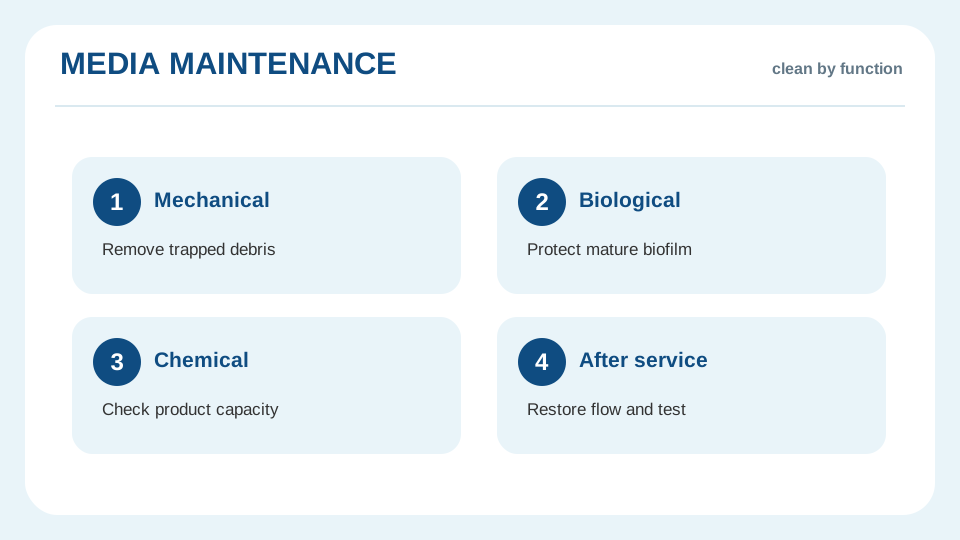
Maintenance has two aims: restore useful water flow and remove accumulated waste while preserving established biological capacity. A dirty mechanical layer needs attention, but stripping every mature surface at once can reduce nitrification. How often you work depends on the media, tank loading and actual flow, not a universal monthly reset.
Mechanical media
Rinse reusable coarse media when substantially loaded. Replace disposable floss or pads when they cannot be cleaned or flow is restricted. If a sponge has served as the tank's main biomedia, avoid treating it like an inert disposable pad; preserve some established surface as you clean it.
Biological media
Leave mature rings, porous media or bio-balls in service unless damaged or the manufacturer directs otherwise. When detritus blocks flow, gently swish or rinse as instructed, using suitable dechlorinated water or removed aquarium water where appropriate. Untreated chlorinated or chloraminated tap water is not the preferred routine wash for established biomedia. Avoid replacing or aggressively scrubbing all mature media together.
Chemical media
Track the reason it was added. Replace or regenerate the product at the interval and method its maker specifies, considering actual exposure and test results. Do not leave spent media in place assuming it continues to bind its target indefinitely.
| Media Type | Clean? | Replace? | Main Maintenance Risk |
|---|---|---|---|
| Mechanical | Yes, if reusable and loaded | When disposable or no longer serviceable | Clogging or leaving waste to decay |
| Biological | Gently, only as needed | Not routinely all at once | Loss of established biofilm |
| Chemical | Only if the product permits regeneration | When exhausted for its purpose | Assuming spent media still works |
Five filter-maintenance mistakes to avoid
- Replacing all established biomedia at the same time.
- Letting mechanical media clog until water bypasses it.
- Discarding every cartridge solely because a calendar says so.
- Using chemical media without a defined target.
- Leaving filtration off for a long period without considering oxygen supply to the biofilter.
Do You Need All Three Types of Aquarium Filtration?
Typical stocked aquariums need a reliable way to process ammonia and nitrite, making biological filtration fundamental. Mechanical capture is highly useful for visible waste and for keeping downstream media open. Chemical media is more situational: choose it for a measurable or observable goal rather than treating it as a required third box to tick.
| Aquarium Situation | Mechanical | Biological | Chemical | Notes |
|---|---|---|---|---|
| Freshwater community | Useful | Fundamental | Optional | Match flow and capacity to stocking |
| Planted tank | Useful | Fundamental | Goal-dependent | Consider plants' nutrient needs |
| Heavily stocked tank | Frequent attention | Higher demand | Specific goals only | Test and remove waste consistently |
| Quarantine or treatment | Useful | Protect capacity | Check medication guidance | Carbon may remove certain treatments |
| Marine tank | Useful | Fundamental | Goal-dependent | Live rock may add biological area |
| Reef tank | Useful | Fundamental | Measured goals | Additional nutrient methods may apply |
Marine systems may also use protein skimming, live rock and other nutrient-management methods. In any setup, stocking, feeding and maintenance set the filter's workload.
Common Filtration Problems and What They Usually Mean
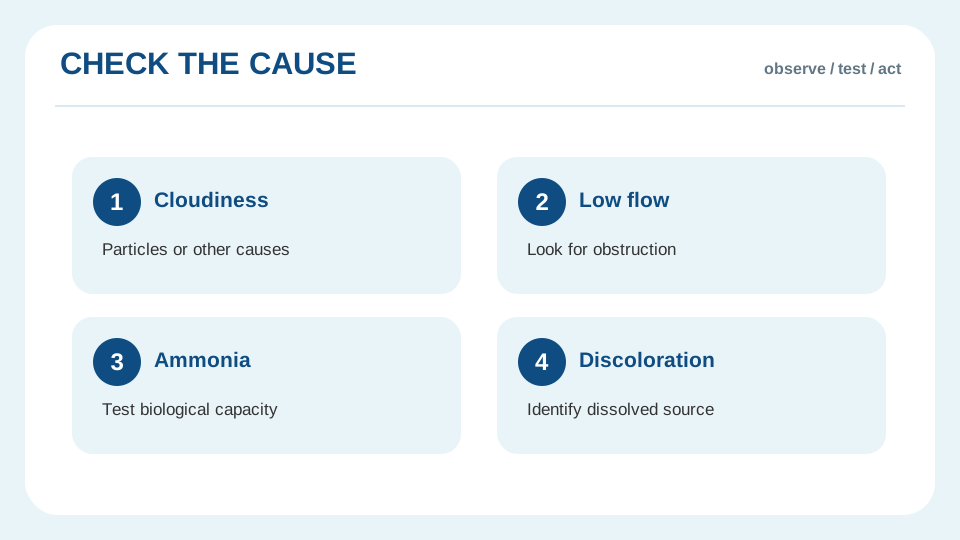
Start with the symptom, then test the likely cause. A visual clue cannot identify every water-quality problem. Cloudiness might be fine debris, a bacterial bloom or disturbed substrate; adding carbon by reflex may miss the cause.
| Problem | Possible Cause | Useful First Action |
|---|---|---|
| Cloudy water | Fine debris, bloom, disturbed substrate, water issue | Test water and identify the kind of cloudiness |
| Reduced flow | Loaded pad, dirty intake, obstructed hose | Inspect the actual water path and clean as appropriate |
| Ammonia or nitrite | New or disrupted biofilter, excess bioload | Test, protect biofilm and address the load |
| Yellow or tannin-colored water | Tannins or dissolved organics | Identify the source; consider targeted media if desired |
| Persistent floating debris | Weak capture, circulation or overloading | Check flow, sponge condition and waste production |
If ammonia or nitrite is detected, focus on livestock safety and cycling status. Check recent media changes, feeding and filter operation.
Frequently asked questions
Frequently Asked Questions About Aquarium Filtration
Short answers for choosing and maintaining media.
What are the three main types of aquarium filtration?
Mechanical filtration catches suspended particles, biological filtration supports microorganisms that convert ammonia to nitrite and then nitrate, and chemical filtration targets selected dissolved substances. A single medium can sometimes do two jobs. For example, a mature sponge traps debris while supporting biofilm. The categories describe functions, not three mandatory products.
Is biological filtration more important than mechanical filtration?
For a normally stocked aquarium, processing ammonia and nitrite is fundamental to animal safety. Mechanical media is also very useful: it captures waste before it circulates, settles or blocks other surfaces. The better question is whether each function is being met. Clear water does not prove healthy nitrogen processing, and a healthy biofilter does not remove every floating particle.
Does every aquarium need chemical filtration?
No. Many aquariums operate without continuous carbon, resin or phosphate media. Add a chemical product when you have a defined goal, such as reducing particular discoloration or a measured compound, and choose media designed for that purpose. It cannot substitute for an established biofilter, sensible feeding or water changes. Follow the product's instructions, especially around medications.
What order should mechanical, biological, and chemical filter media go in?
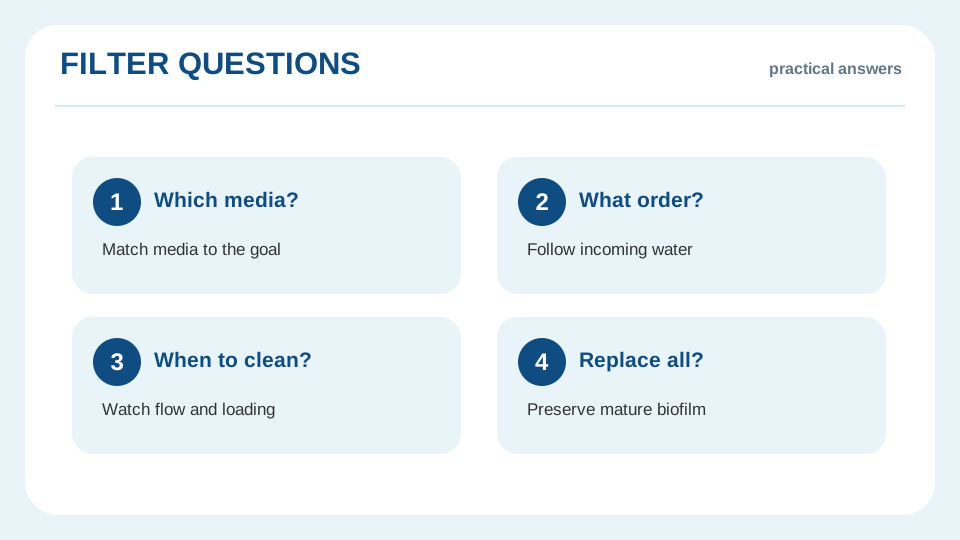
Follow the direction water travels through your specific filter. Coarse mechanical media often meets incoming dirty water first, followed by biological surfaces and optional chemical media. This is a conceptual flow, not a universal top-to-bottom tray layout. Canisters, hang-on-back units, cartridges, sponge filters and sumps route water differently. Check the maker's diagram before moving baskets.
How often should aquarium filter media be cleaned?
Clean mechanical media when debris accumulates or flow falls, and gently clean biomedia only when buildup impairs its function. The interval changes with stocking, food input, plant shedding, media density and filter size. Disposable floss may need replacement sooner than reusable coarse sponge. Look at flow and the condition of the material rather than relying on one fixed schedule for every tank.
Should biological filter media ever be replaced?
Damaged material may need replacement, and a manufacturer's instructions may specify a reason to change a component. Routine replacement of all mature biological media, however, can remove a large part of the established community. If a change is necessary, preserve some working media and monitor ammonia and nitrite while the remaining surfaces adjust. Do not assume a new bag is instantly biologically mature.
Can I rinse aquarium filter media under tap water?
It depends on the media and water treatment. A disposable mechanical pad has different priorities from mature biomedia. Untreated disinfected tap water can expose established biological surfaces to chlorine or chloramine, so follow the manufacturer's guidance and minimize unnecessary damage to biofilm. Suitable dechlorinated water or removed aquarium water is often a practical choice for gentle biomedia cleaning.
Does activated carbon remove ammonia, nitrite, and nitrate?
Standard activated carbon should not be your primary method for controlling these nitrogen compounds. Its common role is adsorption of certain dissolved organics, discoloration, odors and selected treatment residues. An established biofilter handles ammonia and nitrite through nitrification; nitrate requires separate management according to the aquarium. Specialty products may make different claims, so read their specific instructions and verify results by testing.
Can a sponge provide both mechanical and biological filtration?
Yes. Water moving through a sponge leaves particles in its pores, while its wetted surfaces can host nitrifying biofilm once the tank has cycled. The two roles affect maintenance: remove accumulated solids without unnecessarily destroying the mature biological surface. That is why a reusable sponge should not automatically be discarded on a cartridge-replacement schedule.
Does a good aquarium filter eliminate the need for water changes?
No. A standard aerobic biological filter converts ammonia and nitrite but normally leaves nitrate in the system. Dissolved substances and accumulated waste also require ongoing attention. Water changes, testing when appropriate, waste removal, responsible feeding and equipment checks remain part of aquarium care. The amount and frequency of water changed should suit the livestock and measured conditions.
Conclusion
The Best Aquarium Filtration Is About Function, Not More Media
Good filtration starts with identifying the job. A clogged pad needs cleaning or replacement; ammonia or nitrite points toward biological capacity and tank management; a particular dissolved color or compound may call for a suitable chemical medium. Treating all three issues with the same cartridge obscures what is really happening in the aquarium.
Use the actual path of the water when arranging media, and protect established biological surfaces during maintenance. A mature sponge can do two jobs, while an optional chemical pouch should have a clear purpose and an endpoint. Check manufacturer instructions before changing baskets or regenerating specialized media.
- Mechanical filtration captures physical waste.
- Biological filtration supports conversion of ammonia and nitrite.
- Chemical filtration addresses selected dissolved-water problems with appropriate media.
Cycling, testing, water changes, sensible stocking and feeding, and reliable flow all work alongside the filter. Know what problem you are trying to solve before adding, removing, cleaning, or replacing media.
Ask Aqualume
Need Help With Your Aquarium Filtration Setup?
Tell us what equipment or media you are comparing.
Further reading