
Aquarium filtration guide
What Is a Sponge Filter and How Does It Work?
A sponge filter is a porous foam filter placed inside an aquarium, usually powered by an external air pump. Air travels through tubing into the filter. As bubbles rise through its lift tube, they carry water upward and draw surrounding aquarium water through the sponge. The foam catches some suspended debris and gives beneficial bacteria a surface on which to grow.
That simple airlift produces a gentle intake and steady water movement, making sponge filters useful in many shrimp, fry, breeding, and low-flow tanks. They are not automatically sufficient for every aquarium: stocking, waste production, tank size, and desired circulation still matter. This guide explains each part, the two kinds of filtration it provides, how to install and clean it, and when another filter may be a better fit.
At a glance
Quick Reference
- What is it?
- Air-driven filter drawing water through porous foam
- Main filtration
- Mechanical and biological
- Power
- Usually an external air pump
- Parts
- Sponge, core, lift tube, airline, and pump
- Known for
- Gentle flow and protected intake
- Common uses
- Shrimp, fry, breeding, quarantine, low-flow tanks
- Chemical media?
- Not normally, unless an extra media chamber is used
- Care
- Periodically squeeze in removed aquarium water
- Limit
- May not suffice alone for high-waste tanks

Overview
What Is an Aquarium Sponge Filter?
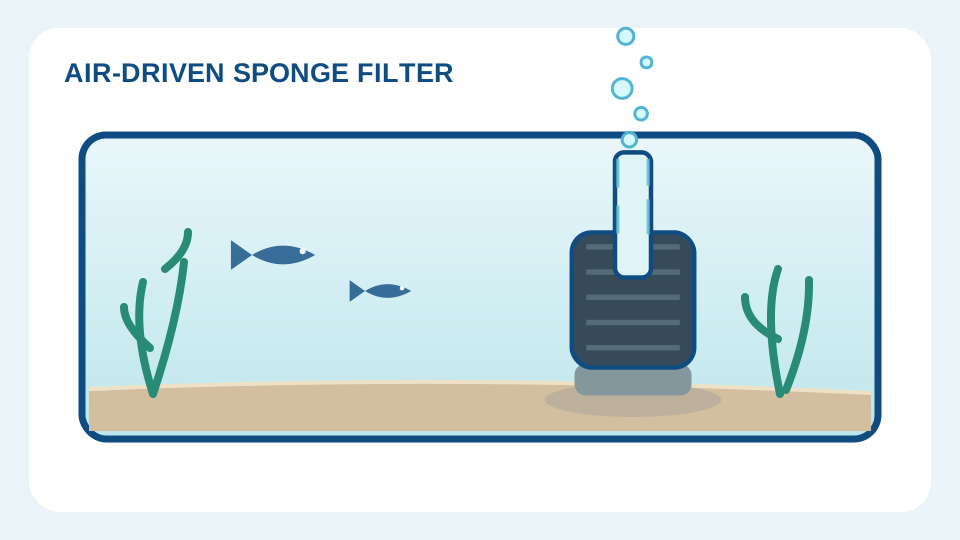
A standalone sponge filter is a foam-covered assembly submerged in a tank. Inside the foam is a plastic core or strainer connected to an upright lift tube. A weighted base or mount holds the filter in place. Airline tubing joins the filter to an air pump outside the aquarium. Some models accept an air stone or diffuser to produce smaller bubbles; designs vary by manufacturer.
The sponge acts as the water intake and the filter medium. Water approaches from a broad area instead of one narrow, exposed inlet. That is a major reason keepers choose it for small animals. The air pump supplies air, while the rising air-and-water column creates the actual flow through the foam.
A pre-filter sponge is different. It covers the intake of a hang-on-back, canister, or other powered filter. It protects livestock and catches debris, but the powered filter remains the primary device moving water. A standalone sponge filter has its own air-driven flow path.
| Component | What it does |
|---|---|
| Sponge | Catches debris; hosts beneficial bacteria |
| Lift tube | Directs rising air-and-water flow |
| Air pump | Supplies driving air |
| Airline tubing | Carries air to the filter |
| Base or mount | Keeps the filter positioned |
| Check valve | Helps stop reverse water flow toward a low pump |
How Does a Sponge Filter Work?
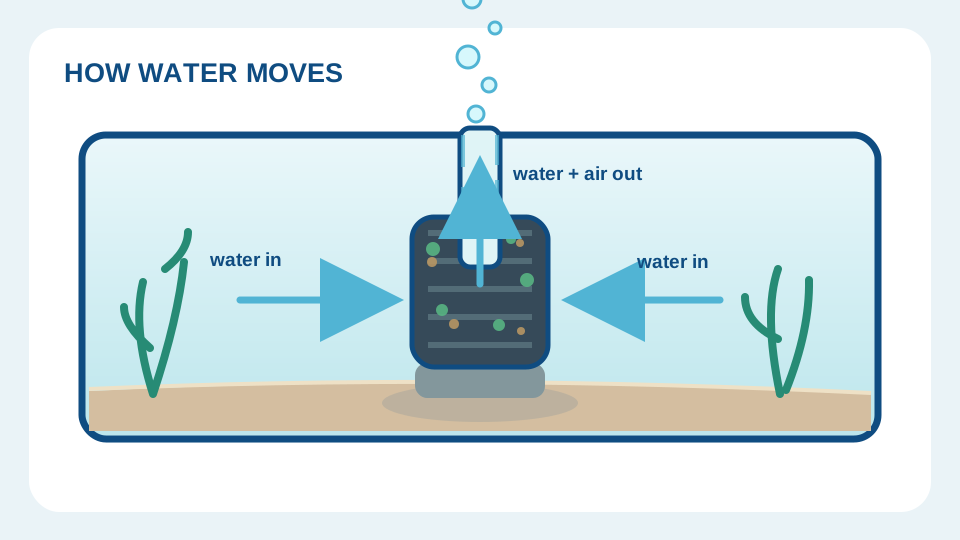
The key is an airlift: bubbles rising inside a vertical tube move surrounding water upward with them. Water leaving at the top must be replaced, so aquarium water passes through the surrounding sponge and into the filter's core. The air pump pushes air; it does not directly suck water through the foam.
- Air leaves the pump through aquarium-safe airline tubing.
- Air enters the filter near the bottom of the internal core.
- Bubbles rise through the lift or uplift tube.
- Water travels upward with the bubbly column.
- Replacement water enters through the sponge's porous walls.
- Foam catches particles such as suspended food and waste.
- Microorganisms on the foam process dissolved nitrogen waste once the filter is established.
- Water returns to the tank at the top, while bubbling disturbs the surface.
Water flow at a glance: Aquarium water → sponge → internal core → lift tube → aquarium.
Flow depends on the pump, airline, filter design, sponge pore size, and how much debris has accumulated. A stronger pump does not guarantee a proportional increase in filtration. Large bubbles may simply splash more, and dense or clogged foam can restrict incoming water. Watch actual circulation rather than judging only by the sound or size of the bubbles.
The returning water and surface agitation help expose more water to the air, supporting gas exchange. The bubbles themselves are not a substitute for checking oxygen conditions when fish show distress. Surface movement, temperature, stocking, and the needs of the species all influence whether the system is adequate.
What Filtration Does a Sponge Filter Provide?

Mechanical Filtration
As water crosses the foam, its pores retain some suspended fish waste, food, plant fragments, and other particles. This is mechanical filtration: physical capture rather than chemical removal. Material held in the sponge stays there until the keeper rinses or squeezes it out. A filter can therefore look dirty while still moving water, yet neglecting that buildup eventually reduces flow.
Coarser foam usually lets water move more easily and catches larger debris. Finer foam can hold smaller particles but may clog sooner. Neither design automatically polishes water as finely as a dedicated fine pad or floss stage. The actual result depends on the foam and the flow through it.
Biological Filtration
The sponge offers many wetted surfaces for a microbial biofilm. Among its residents are nitrifying microorganisms that convert ammonia to nitrite and nitrite to nitrate as part of an established nitrogen cycle. Ammonia originates largely from animal waste and decomposing organic matter. Both ammonia and nitrite need monitoring in a new or disturbed tank.
That biological role can be more valuable than the sponge's appearance suggests. Brown discoloration does not mean the foam has failed. The aim of cleaning is to clear excess trapped waste while keeping useful biofilm and restoring flow, not to sterilize every pore.
What About Chemical Filtration?
A standard foam-only sponge filter has no dedicated chemical media stage. Activated carbon, resins, or other specialty media need a suitable chamber or another filter. Some modified sponge-filter models include extra compartments, so check the actual product rather than assuming every model performs the same functions.
| Function | Standard sponge filter |
|---|---|
| Mechanical filtration | Yes |
| Biological filtration | Yes, once established |
| Chemical filtration | Usually no |
| Fine water polishing | Limited |
| Surface agitation | Yes, when air driven |
Why Do Aquarists Use Sponge Filters?
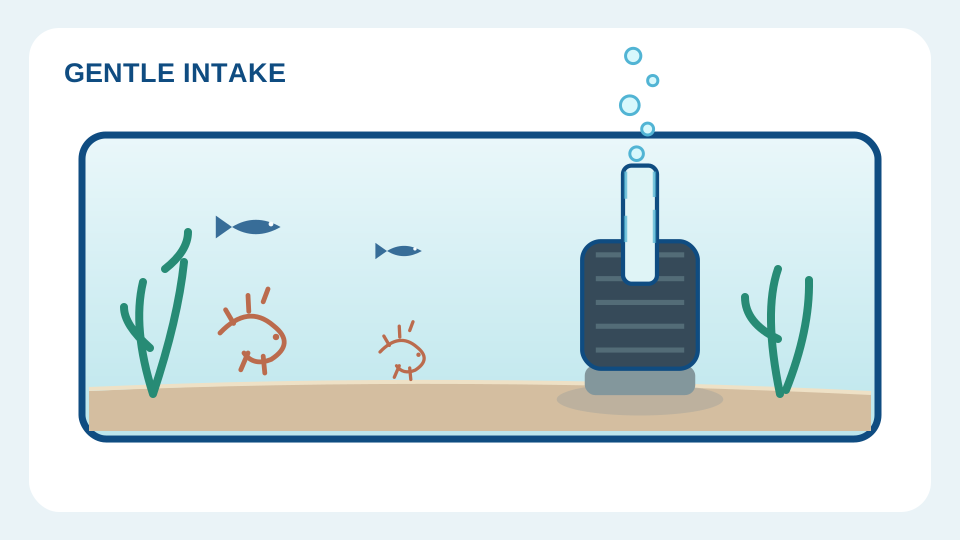
The broad foam intake spreads suction over many pores. Shrimp and fry are less likely to be pulled into an exposed inlet, and the gentler water movement can suit fish that struggle in a strong current. This is an advantage, not a guarantee of safety: select a suitable sponge size and inspect small animals and flow after installation.
- Biological surface: foam provides room for beneficial bacteria when kept wet and supplied with flowing water.
- Simple construction: few moving parts sit inside the tank, making the filter easy to inspect.
- Flexible air supply: a suitably sized pump can sometimes operate more than one air-driven device.
- Backup capacity: an established extra sponge can support filtration when a new tank or filter is prepared, with attention to disease transfer.
- Surface movement: continuous bubbling encourages circulation and surface gas exchange.
- Accessible care: foam can usually be detached and cleaned without complex media baskets.
Good Use Cases
- Breeding and fry grow-out tanks
- Shrimp aquariums
- Quarantine or hospital tanks, with suitable disease-control practices
- Betta or other low-flow setups when airflow is adjusted appropriately
- Backup biological filtration
- Lightly stocked community aquariums
Cost and operating noise depend on the pump and equipment chosen. Consider the aquarium's total waste and desired circulation before deciding that a sponge filter should be the only filter. Its strengths are most useful when they align with the livestock's needs.
What Are the Limitations of Sponge Filters?
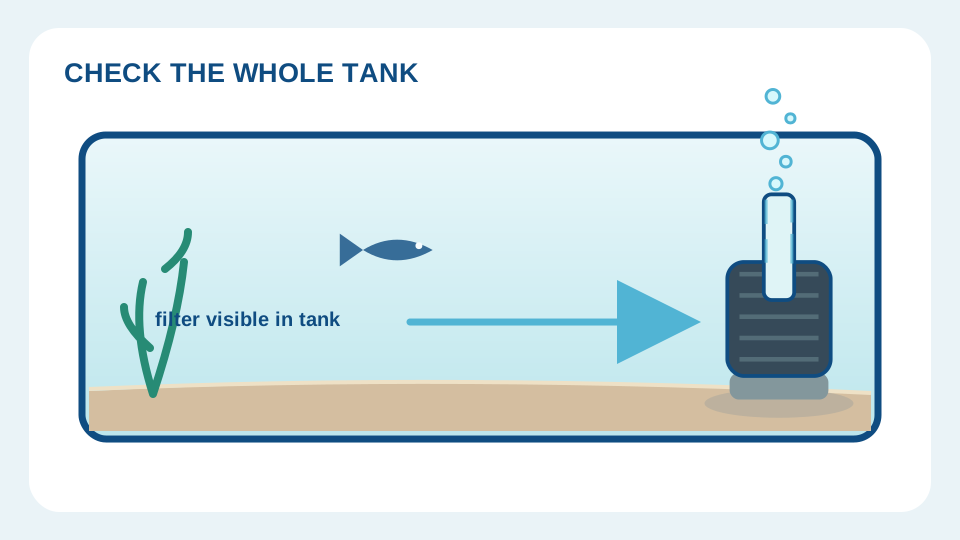
A sponge filter has modest media flexibility. Standard foam does not provide a chamber for carbon or other chemical media, and very fine suspended particles may remain in the water. Captured waste also stays inside the aquarium until the sponge is cleaned. If debris clogs the pores, water flow falls.
The equipment is visible in the tank. An external pump can hum or vibrate, and large bubbles may make audible splashing. Better pump placement, a compatible diffuser, or adjusted airflow may reduce noise, but a completely silent result should not be assumed.
Capacity is context dependent. A large tank with heavy stocking, messy fish, or strong directional-current needs may require a larger or different filter, additional circulation, or multiple filtration stages. A sponge's healthy bacterial colony is useful, but it cannot compensate indefinitely for more waste than the system can process. Test water and observe animals when evaluating performance.
| Advantages | Limitations |
|---|---|
| Gentle, protected intake | Limited fine-particle polishing |
| Useful biological surface | Usually no chemical media |
| Fry and shrimp friendly | Sponge needs periodic cleaning |
| Simple construction | Pump and bubbles may be noisy |
| Few moving parts in tank | Not sufficient alone for every tank |
| Surface agitation | Visible equipment in aquarium |
Sponge Filter vs. Other Aquarium Filters

Different filters move water and hold media in different ways. A hang-on-back (HOB) filter hangs over the tank rim. An internal power filter uses a submerged motor. A canister sits mostly outside the aquarium and pumps water through enclosed media. Each can support biological filtration when maintained correctly.
| Feature | Sponge | HOB | Internal | Canister |
|---|---|---|---|---|
| Flow | Gentle | Moderate | Moderate | Moderate to strong |
| Biological | Strong when mature | Strong | Varies | Strong |
| Mechanical | Basic to moderate | Good | Good | Good to excellent |
| Chemical media | Usually absent | Common | Sometimes | Common |
| Fry or shrimp intake | Protected | Often needs a pre-filter | Varies | May need a pre-filter |
| Care complexity | Low | Low to moderate | Low to moderate | Moderate |
| Location | Tank + external pump | Tank rim | Inside tank | Mostly outside |
The table describes common designs, not a universal ranking. A HOB can be adjusted or fitted with an intake sponge; canister flow can be distributed with suitable outlets. Conversely, some compact power filters offer little media space. Compare the actual model, not only the category name.
Choose by tank size, species, stocking, waste production, required flow, room for equipment, and the care routine you can maintain. Some aquarists run a sponge beside a powered filter: the first adds a gentle intake and established biological surface, while the second supplies more directed flow or media options.
How to Set Up a Sponge Filter
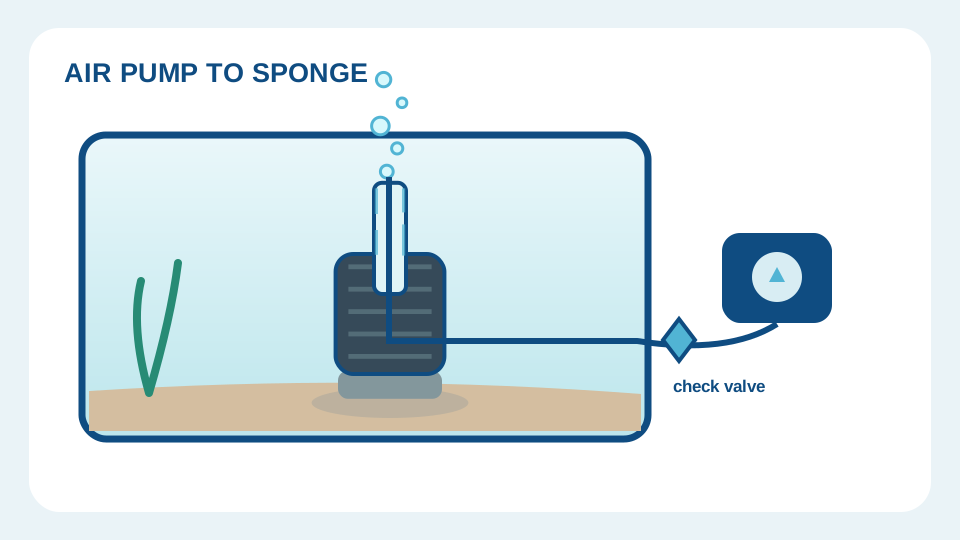
What You Need
- Appropriately sized sponge filter
- Air pump and aquarium-safe airline tubing
- Check valve when the pump sits below the aquarium water level
- Optional airflow-control valve
- Optional air stone if the filter design supports one
- Choose a filter and pump suited to the tank and expected biological load.
- Assemble the sponge, base, core, and lift tube according to the maker's directions.
- Attach the airline firmly to the filter connection.
- Run the airline to the external pump without sharp kinks.
- If the pump sits below water level, insert a compatible check valve in the correct direction.
- Submerge the filter fully; gently squeeze trapped air from the foam if it floats.
- Position it where water can move around the sponge and the tube can discharge freely.
- Switch on the pump and confirm a consistent bubble stream.
- Observe water movement at the tube outlet and around the tank.
- Check the tubing, valve, and fittings for leaks or restrictions.
Electrical safety: Follow the pump manufacturer's installation instructions and use drip loops where required. Keep electrical connections away from splashes and check that any valve faces the correct direction.
An air stone is optional, not a missing mandatory part. Some designs work well without one; others use a diffuser to change bubble size or noise. Let the installed filter run and observe the animals before increasing airflow simply to create a larger bubble plume.
Does a New Sponge Filter Work Immediately?
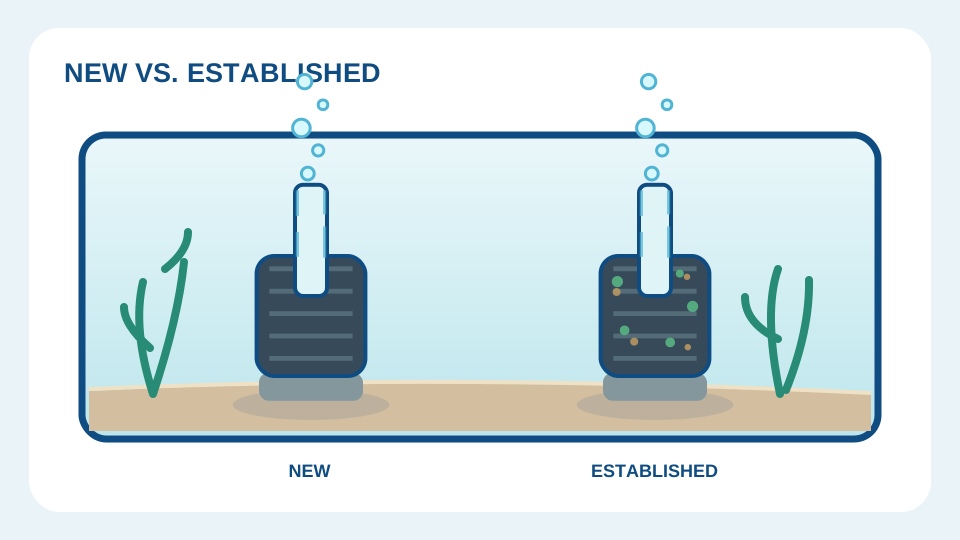
Water movement and physical debris capture begin when the air pump starts. Biological filtration is different. A new, clean sponge does not instantly contain a mature colony capable of processing the tank's full ammonia and nitrite load. Microorganisms establish over time as the aquarium cycles, provided suitable conditions and a waste source are present.
| Function | New sponge | Mature sponge |
|---|---|---|
| Water movement | Immediate | Immediate |
| Mechanical capture | Immediate | Immediate |
| Established bacterial colony | No | Yes, if maintained |
| Biological capacity | Developing | Depends on condition and bioload |
Seeding means introducing microorganisms using an established sponge or mature biological media. It may help start another filter, but it can also transfer pathogens or contaminants between tanks. Do not share media from a sick aquarium with a healthy one. Even with mature media, monitor ammonia and nitrite; moving a sponge does not guarantee that a new tank can safely support any stocking level immediately.
If another filter already supports the aquarium, running the new sponge alongside it gives the foam time to colonize. Avoid removing the established filter merely because the new sponge has begun bubbling. The capacity to process waste is developed and tested, not inferred from motion alone.
How to Clean a Sponge Filter Without Damaging the Biofilter

Clean when the foam collects excess debris or flow declines; there is no useful calendar interval for every tank. Stocking, feeding, pore density, sponge size, and pump output all change the rate of clogging. A somewhat dark sponge can be functioning normally. The goal is to restore water movement without unnecessarily stripping the biological film.
- Save some aquarium water during a normal partial water change.
- Stop airflow or disconnect the unit according to its instructions.
- Lift the sponge carefully; a small container can keep trapped waste from spilling back.
- Place the foam in the removed aquarium water.
- Gently squeeze and release it several times.
- Discard the dirty water; do not try to make the sponge sterile white.
- Inspect and reassemble the core, tube, and base.
- Return the filter to the aquarium.
- Restore airflow and check that bubbles and circulation have returned.
Using removed tank water avoids exposing established biofilm to untreated chlorinated or chloraminated tap water. Never clean the foam with soap, household chemicals, or boiling water. Replace a sponge when the foam physically breaks down or no longer works, not just because it is discolored.
| Symptom | Possible cause | Check |
|---|---|---|
| Fewer bubbles | Restricted air path or dirty diffuser | Pump, tubing, valve, diffuser |
| Weak water flow | Clogged foam | Gently clean the sponge |
| No bubbles | Pump or tubing problem | Complete air path |
| Sponge floats | Trapped air | Submerge and squeeze gently |
| Too much noise | Large bubbles or vibration | Diffuser and pump placement |
How to Choose the Right Sponge Filter

There is no universal formula that turns tank volume alone into the correct sponge size. A lightly stocked aquarium and a crowded one of the same volume can produce very different waste loads. Consider the animals, feeding, sponge area, available airflow, intended current, and whether this is the only filter or a supplement.
Coarser foam generally permits easier flow and clogs less quickly but catches larger particles. Finer foam can retain smaller particles, though buildup may restrict it sooner. Pore descriptions are not always standardized across brands, so compare actual specifications and cleaning needs. A very dense sponge paired with a weak pump can move less water than expected.
Follow the filter and pump manufacturers' operating ranges, then observe performance in the real aquarium. Look for movement at the outlet, debris accumulation, water-test trends, and how livestock behaves. If one unit cannot supply sufficient circulation or waste processing, add suitable filtration rather than assuming a bigger air pump alone solves every problem.
When Should You Use a Sponge Filter?
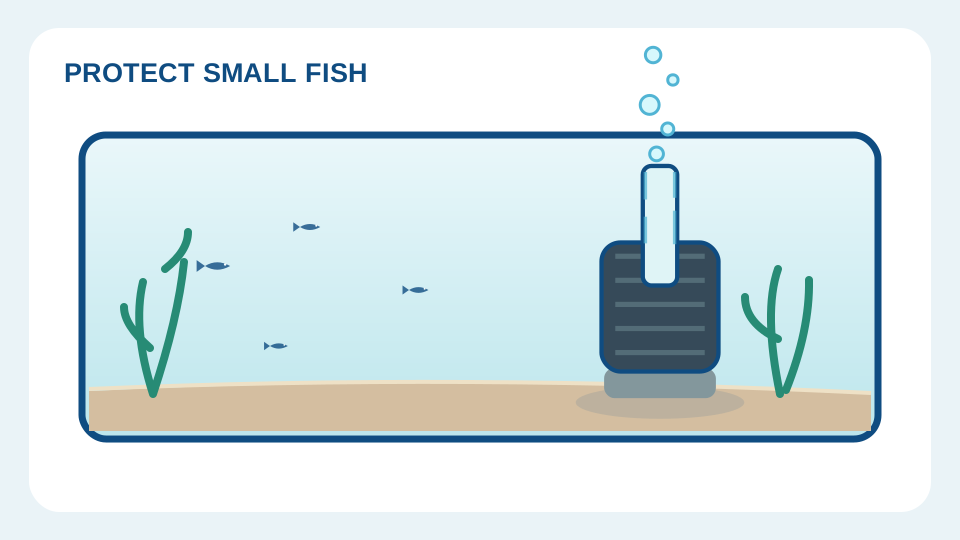
Choose a sponge filter when a protected intake, gentle current, and accessible biological medium fit the tank. It often works well in shrimp and breeding systems; it can also be a practical companion to another filter. The table describes typical suitability, not an automatic prescription for every species or stocking level.
| Aquarium situation | Sponge filter fit |
|---|---|
| Shrimp tank | Very suitable |
| Breeding or fry tank | Very suitable |
| Quarantine tank | Often suitable; manage cross-contamination |
| Low-flow community tank | Often suitable with appropriate stocking |
| Large, heavily stocked tank | May need additional filtration |
| Strong-current tank | Usually needs extra circulation |
| Regular chemical media needed | Use another or supplemental media system |
Observe whether particles settle in dead spots and whether tank water stays within safe tested ranges. If a second filter is already present, a mature sponge can add resilience, but maintain each unit properly. The right setup meets the animals' needs and remains manageable for the keeper.
Frequently asked questions
Frequently Asked Questions About Sponge Filters
Answers to the questions most likely to come up after setup.
Does a sponge filter actually clean aquarium water?
Yes. Water moving through the foam leaves some suspended particles behind. In an established filter, microorganisms on the sponge also process dissolved nitrogen waste. It does not remove every contaminant or replace water changes, and debris on the substrate still needs ordinary maintenance.
Does a sponge filter need an air pump?
Most conventional standalone models need an external air pump and airline tubing. Some designs can be driven by a powerhead or another compatible water-moving device. Check the exact model before buying parts; a bare sponge without a source of flow does not function as a complete standalone filter.
Does a sponge filter provide oxygen?
The bubbling and water movement can promote gas exchange at the surface, helping oxygen enter and carbon dioxide leave the water. The foam itself does not manufacture oxygen. Whether aeration is sufficient depends on temperature, stocking, surface movement, and the animals' needs.
Can I use only a sponge filter in my aquarium?
Sometimes. A suitably sized, mature sponge filter may support a lightly stocked tank, but large, high-waste, or strong-flow systems can need more. Assess water-test trends, actual circulation, and the species rather than relying on a tank-volume label alone.
Are sponge filters good for betta fish?
They can be useful because the broad intake and adjustable airflow usually allow a gentler current than many powered outlets. Betta fish still need suitable water quality and temperature. Adjust the pump if the surface is too turbulent or the fish struggles to move comfortably.
Are sponge filters safe for shrimp?
A porous, covered intake greatly reduces the exposure of small shrimp to a narrow suction opening. Shrimp may also graze biofilm on the foam. Choose a suitable pore size, seat the sponge securely, and check that any other filter in the tank has its intake protected too.
Are sponge filters safe for baby fish?
They are widely used in fry tanks because the intake is distributed over foam rather than concentrated at a bare pipe. Newly hatched fish are still species dependent, so inspect the actual sponge pores and flow. Feeding, water changes, and biological capacity remain just as important as intake safety.
How often should I clean a sponge filter?
Clean according to debris loading and reduced flow, not one fixed date. A heavily fed breeding tank may clog faster than a lightly stocked aquarium. Check the sponge when bubbles or water movement change, and gently squeeze out excess waste in removed aquarium water.
Can I wash a sponge filter under tap water?
Many keepers prefer removed aquarium water because untreated tap water can contain chlorine or chloramine that harms biofilm. If the sponge is an established biological medium, avoid unnecessary disinfectant exposure and never use soap. The aim is to remove trapped solids, not sterilize the foam.
How long does a sponge filter last?
The foam can remain useful for a long time if it holds its shape and water passes through it. Replace it when it tears, crumbles, will not stay mounted, or no longer functions after appropriate cleaning. Brown coloration alone is not a reason to discard mature media.
Can a sponge filter remove ammonia?
The foam normally does not chemically absorb ammonia. In a cycled aquarium, nitrifying microorganisms living on it convert ammonia to nitrite and then nitrate. A new sponge has not yet built that capacity, so monitor water parameters whenever the tank is cycling or the biological filter has been disturbed.
Does a sponge filter remove fish waste?
It catches some waste and food particles suspended in moving water. Waste settled on the substrate or trapped behind decorations may never reach it and should be removed during routine cleaning. Squeezing the sponge periodically exports the debris it did collect.
Do sponge filters work in saltwater aquariums?
The airlift and foam-filtration principles can work in marine water. Whether a sponge filter is appropriate depends on the full system's waste load, circulation, oxygenation, and filtration plan. It should not be assumed to replace equipment required for a particular marine setup.
Conclusion
Is a Sponge Filter Right for Your Aquarium?
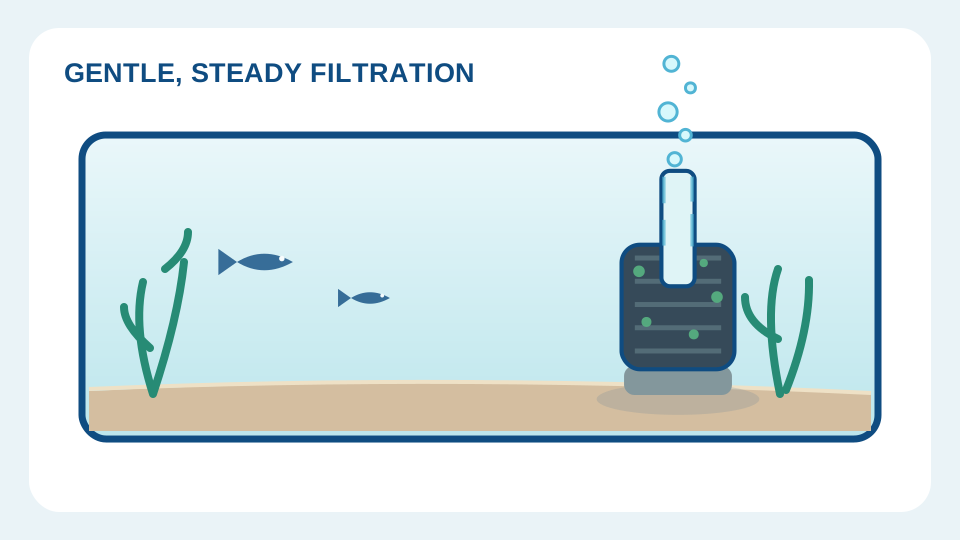
A sponge filter combines physical debris capture with biological filtration in a simple air-driven unit. Rising bubbles move water up the lift tube; water entering through the foam carries particles into its pores and passes a growing bacterial biofilm. The broad intake and modest current make this especially useful for fry, shrimp, breeding, and many quarantine or low-flow tanks.
Its simplicity has limits. The standard foam does not supply a chemical media stage or strong directional flow, and it needs cleaning when debris restricts circulation. Whether it can stand alone depends on tank size, livestock, feeding, and waste load. Test water and observe the actual aquarium rather than trusting a category label.
For the right tank, a few accessible components provide continuous movement and a stable home for useful microorganisms. Choose the sponge and pump for the animals you keep, give a new filter time to establish, and maintain it without sterilizing its biological surface.
Ask Aqualume
Have a Question About Aquarium Filtration?
Send your filtration question or tell us which topic you would like us to cover next.
Further reading
Related Aquarium Filtration Guides
 Filtration basics
Mechanical, Biological, and Chemical Filtration
Compare filter media roles and learn how the nitrogen cycle depends on a living biofilter.
 Aeration
What Is Dissolved Oxygen in Aquarium Water?
Understand gas exchange, circulation, and when fish behavior deserves a closer look.
 Tank care
What Causes Algae Growth in an Aquarium?
Trace how light, waste, plants, and water flow influence nuisance growth.