
Beginner aquascaping guide
What Is Aquascaping? A Complete Beginner’s Guide to Underwater Landscapes
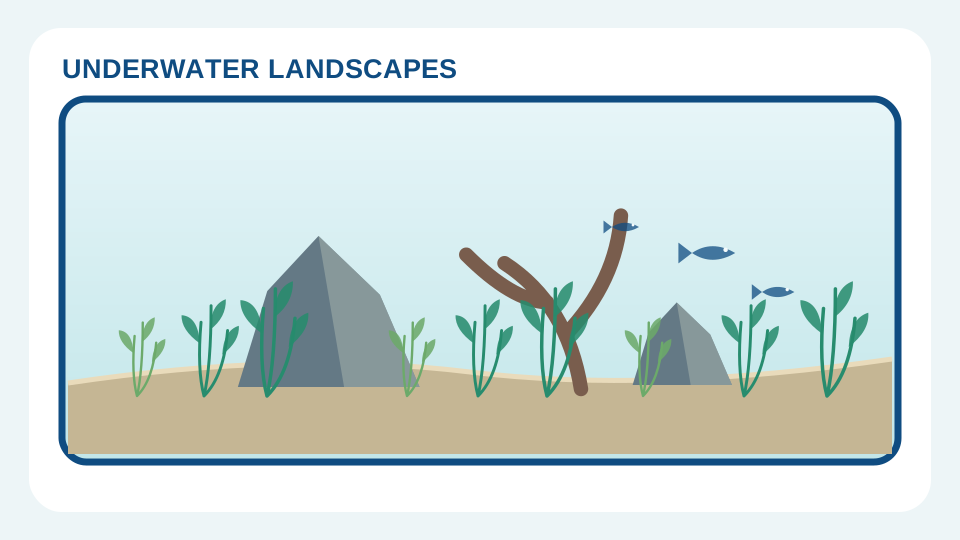
Aquascaping is the deliberate arrangement of plants, rocks, wood, and open water inside an aquarium. The result is a living underwater landscape whose appearance changes as plants grow and the tank matures. A layout may suggest a forest, a mountain valley, a riverbank, or simply an appealing arrangement of aquatic plants. The design has to work for the living organisms inside it, too.
You do not need a competition tank, injected CO₂, or rare plants to begin. A modest aquarium with stable filtration, suitable light, and a few hardy plants can teach the central ideas. This guide explains the styles, materials, design choices, setup steps, and maintenance habits that make an aquascape both attractive and sustainable. Use it to choose a realistic first project rather than copy a finished photograph without knowing what supports it.
At a glance
Quick Reference
- Definition
- Intentional underwater landscape design
- Core elements
- Tank, substrate, hardscape, plants, light, and filtration
- Main styles
- Nature, Iwagumi, Dutch, Jungle, and biotope-inspired
- Fish
- Optional; choose livestock to suit the finished layout
- Injected CO₂
- Optional for many beginner plants
- Difficulty
- Varies with plants, equipment, and expectations
- Ongoing care
- Water changes, trimming, cleaning, and observation
Overview
Aquascaping at a Glance
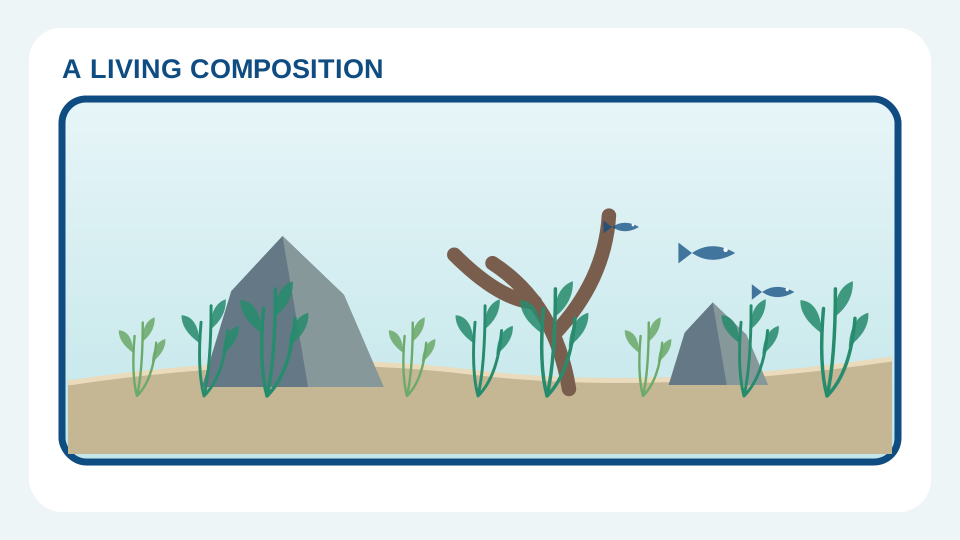
Think of an aquarium as a small environment and an aquascape as a considered arrangement within it. The glass sets the boundary; substrate forms the ground; stones and driftwood establish structure; plants bring texture, movement, and changing shape. Fish and invertebrates may add life, but an aquascape can be complete without them. The point is a coherent composition, not the maximum number of objects.
Good aquascaping joins three priorities. Composition gives the viewer a clear route through the scene. Plant health depends on species whose light, nutrient, and carbon needs match the system. Environmental stability comes from suitable filtration, circulation, water conditions, and patient maintenance. A striking photograph is only one moment in a living process.
Beginners can start with hardy plants, a small set of compatible stones or wood, and a simple plan for open space. Larger or more demanding displays may use stronger lighting and pressurized CO₂, but those are choices tied to the plants and desired growth rate. First learn what each element contributes. Then plan a layout that you can actually maintain after the initial planting day.
- Choose one visual direction.
- Match plants to the equipment.
- Let the aquarium establish and mature.
What Does Aquascaping Actually Mean?
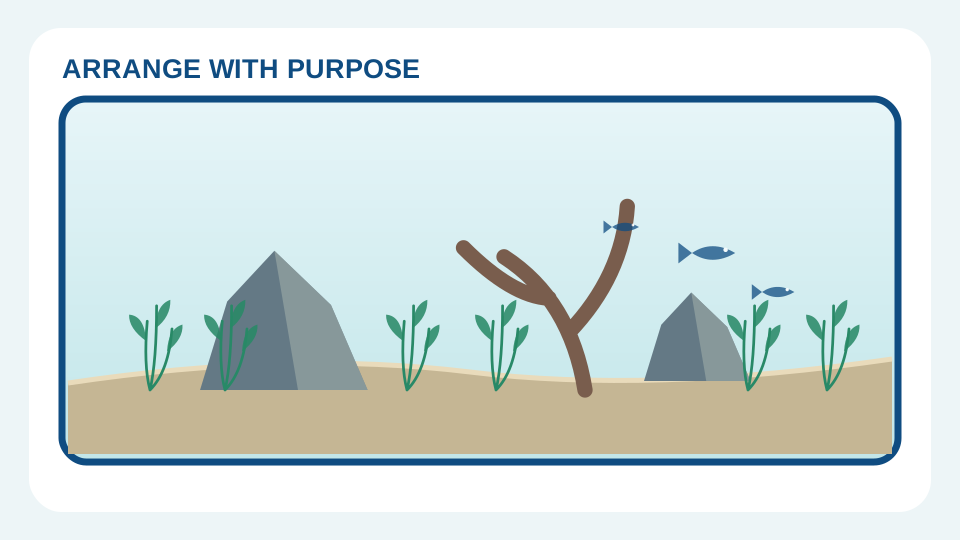
Aquascaping means arranging an aquatic setting with visual intent. Its materials are not merely decorations placed wherever they fit. A stone may establish the focal point, wood may lead the eye across the tank, and a low plant may keep the foreground open. The layout considers the view from outside the glass and the conditions inside it.
The word hardscape covers the nonliving structural materials, usually rocks and driftwood. Substrate is the material on the bottom, such as sand, gravel, or planted-tank soil. An active substrate is a prepared soil that can supply nutrients and alter water chemistry; its effect depends on the product and water used. Aquatic plants complete much of the visual scene, but their mature size matters more than how a tiny starter pot looks on planting day.
A design can be spare or dense, symmetrical or asymmetric, naturalistic or more stylized. Those are aesthetic decisions. Plant species, water quality, and livestock compatibility impose biological limits. When the two sides work together, the viewer sees a landscape while the keeper manages an actual aquarium ecosystem.
A Useful Working Vocabulary
- Foreground: the area nearest the viewing glass.
- Midground: the transition around stones, wood, and medium-height plants.
- Background: the rear planting or open area that frames depth.
- Focal point: the place where the eye settles first.
- Negative space: deliberately open water or substrate that gives the design room to breathe.
Aquascaping vs. a Regular Aquarium vs. a Planted Aquarium

These labels overlap. A fish aquarium focuses primarily on the welfare and display of its animals. A planted aquarium intentionally grows aquatic plants. An aquascape emphasizes the overall arrangement, using plants and hardscape as parts of a composition. Many aquascapes are planted aquariums with fish, but neither fish nor living plants define every possible design.
| Type | Main emphasis | Plants and hardscape | Visual planning |
|---|---|---|---|
| Regular fish aquarium | Livestock care and viewing | May be simple or absent | Optional |
| Planted aquarium | Growing aquatic plants | Plants are central | Varies widely |
| Aquascape | Coherent underwater composition | Chosen for a deliberate scene | Central to the project |
A densely planted tank can be healthy and enjoyable without following a specific composition. Conversely, a hardscape-led display may have few plants yet still have an intentional visual structure. The labels are descriptions, not quality grades. Whatever the style, animal welfare and stable water conditions remain essential whenever livestock is present.
A Brief History of Aquascaping

People have kept and arranged aquarium plants for many decades. Dutch-style planted displays took shape among Netherlands aquarium keepers in the 1930s, with an emphasis on ordered groups of contrasting plants. Rather than treating rocks as the leading feature, the plants themselves formed the architecture. Exact dates for any single layout are less important to beginners than understanding this design approach.
Later, Takashi Amano drew on natural landscapes in his Nature Aquarium layouts. He founded Aqua Design Amano in 1982, and his photographs, books, and aquarium work helped bring nature-inspired aquascaping to a broad international audience. Stone-focused Iwagumi compositions became another influential visual language. Modern keepers mix ideas freely, so the style names are helpful starting points rather than fixed categories.
| Period | Development |
|---|---|
| 1930s | Dutch planted-aquarium traditions emphasize structured plant groups. |
| 1982 | Takashi Amano founds Aqua Design Amano. |
| Later decades | Nature Aquarium, Iwagumi, and diverse local approaches spread through books, clubs, and online communities. |
The Essential Elements of an Aquascape
Tank and Substrate
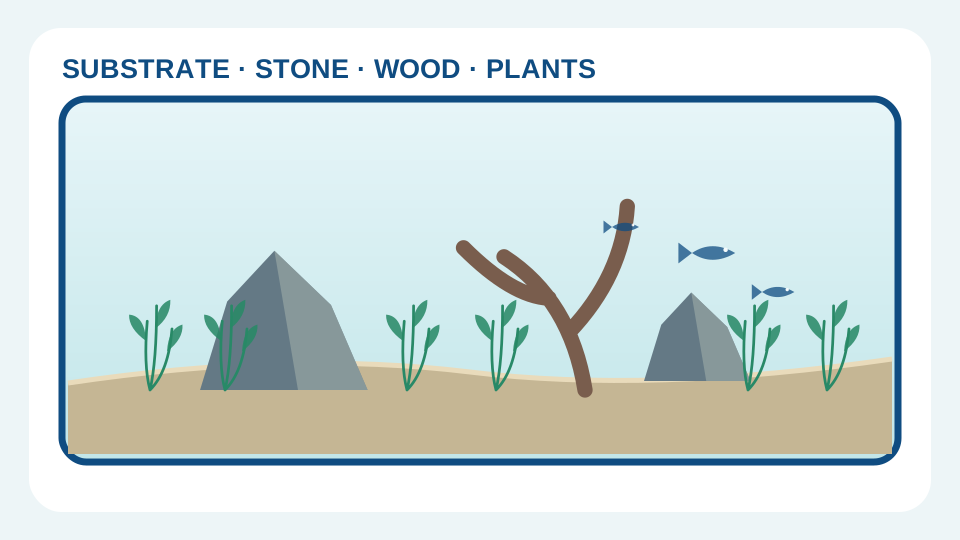
The tank is the physical canvas. Its footprint affects how much room you have for depth, plant groups, open swimming space, and equipment. A larger volume may buffer some changes, while a small tank can make every placement and maintenance lapse more visible. Select a safe stand and a size you can service comfortably.
Substrate anchors rooted plants and helps form the terrain. Sand and gravel can give a clean visual base; nutrient-rich aquascaping soil can support selected plants. Sloping the substrate upward toward the rear can create a sense of distance. Keep slopes stable and consider how the chosen material may affect the water.
Hardscape and Plants
Rocks and driftwood establish the design before growth fills it in. Choose materials suitable for aquarium use, check whether certain rocks alter water chemistry, and make sure every heavy piece is secure. Repeating a limited range of textures usually creates a clearer scene than mixing many unrelated materials.
Plants add scale, color, and living form. Short foreground species can create an open meadow effect; midground plants soften a stone base; taller background species provide a backdrop. Epiphytes such as some ferns and Anubias attach to wood or rock rather than being buried by their rhizome. Carpet plants spread across the substrate but differ greatly in light and CO₂ requirements.
Light, Filtration, and Nutrients
Lighting supplies energy for photosynthesis. More intense light increases plant demand for carbon and nutrients, so it should match the species and maintenance plan. Filtration captures particles and supports biological filtration: microbes that convert harmful ammonia into nitrite and then nitrate. Water movement distributes heat, nutrients, and, where used, dissolved CO₂.
Plants also need suitable nutrients. Some take much of their nutrition from the water column, others from the substrate, and many use both. CO₂ injection adds pressurized carbon dioxide to the water; it can support demanding plants and faster growth but is not a universal requirement. Choose the plant list first, then determine whether the system needs extra equipment.
| Element | Primary role |
|---|---|
| Tank | Defines the physical canvas |
| Substrate | Anchors plants and shapes terrain |
| Hardscape | Creates structural composition |
| Plants | Add living texture, color, and scale |
| Light | Powers photosynthesis |
| Filtration | Supports water quality and circulation |
| Nutrients | Support plant growth |
| CO₂ | Can support demanding or faster plant growth |
| Livestock | Adds movement and biological complexity |
The Main Aquascaping Styles

Styles give you a vocabulary for planning. They are not rules that every aquarium must obey. A personal layout may borrow a stone grouping from Iwagumi, layered planting from Nature Aquarium, and a looser Jungle feeling without fitting one label perfectly.
Nature Aquarium
Nature Aquarium layouts take visual cues from forests, hillsides, river edges, and other landscapes. Wood or stone provides a structural framework, and plants grow in layers around it. Asymmetry, perspective, and open space help the tank feel larger than its glass dimensions. The composition can be elaborate, but a beginner can start with one dominant piece of wood and a few easy plants.
Iwagumi
Iwagumi centers on stones. Traditional examples have a dominant stone supported by smaller stones, a limited plant palette, and considerable negative space. Low carpeting plants are common, which can make a visually minimal display technically demanding. Modern Iwagumi-inspired tanks vary; no single stone count guarantees a good composition. Consider plant growth requirements before choosing this look as a first project.
Dutch Style
Dutch layouts put aquatic plants at the center of the design. Distinct groups contrast leaf shape, height, texture, and color, often with little visible hardscape. Trimmed plant “streets” can draw the eye into depth. The result depends on regular pruning and replanting, because one fast-growing species can quickly hide another.
Jungle Style
Jungle aquascapes favor dense foliage and a more informal, layered impression. Plants may overlap and conceal much of the hardscape. A visually forgiving style can still require trimming, sufficient circulation, and sensible plant selection. “Natural-looking” does not mean that maintenance can be ignored.
Biotope-Inspired Aquascaping
A strict biotope aims to represent a particular habitat, considering its organisms, water, substrate, and geographic setting. A biotope-inspired aquascape borrows the character of a habitat without claiming that every element is authentic to one location. Do not label an ordinary naturalistic layout a verified biotope unless its ecological choices support that claim.
| Style | Main focus | Hardscape | Plant variety | Character |
|---|---|---|---|---|
| Nature Aquarium | Landscape impression | Important | Moderate | Organic, balanced |
| Iwagumi | Stone composition | Dominant | Low | Minimal, open |
| Dutch | Aquatic plants | Often minimal | High | Structured, colorful |
| Jungle | Dense vegetation | Secondary | Moderate to high | Lush, informal |
| Biotope-inspired | Habitat character | Habitat-dependent | Habitat-dependent | Naturalistic |
To choose a direction, compare the appearance you like with your plant experience, available equipment, desired livestock, and time for trimming. An achievable interpretation of a style is more satisfying than a complex layout that cannot be maintained.
Core Aquascaping Design Principles
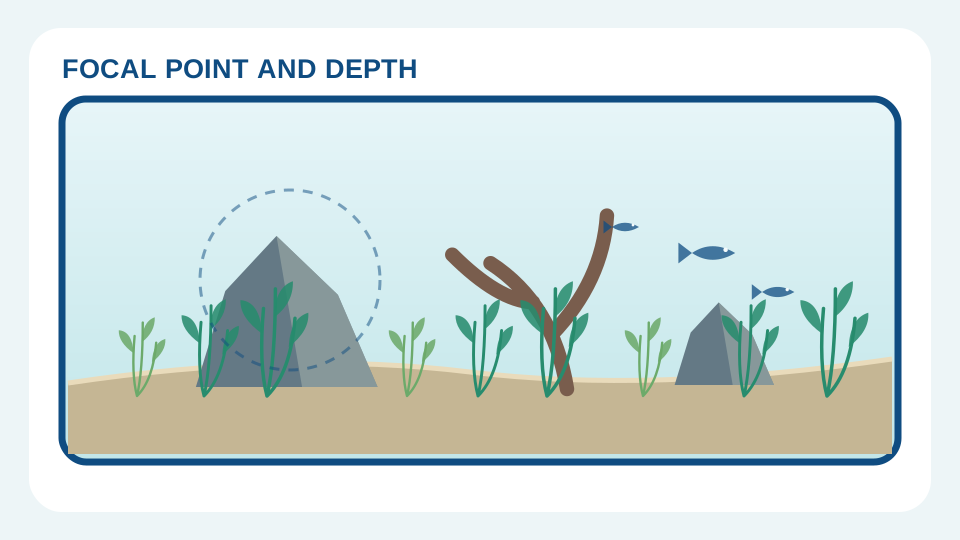
Healthy plants alone do not guarantee a coherent view. Start with a focal point: a distinctive stone, the base of a branching wood piece, or a gap that draws the eye. The rule of thirds suggests placing that feature near one of the lines that divide the view into thirds. It is a planning tool, not a requirement.
Balance does not require mirror symmetry. A large stone on one side can be visually balanced by a broader plant group on the other. Repeating a few materials, controlling their size, and leaving negative space prevents every object from competing for attention. Small-leaved plants and suitably scaled stones can make a miniature landscape feel expansive.
Depth is partly an illusion. A higher rear substrate line, overlapping hardscape, lower foreground plants, and smaller details farther back all suggest distance. An open path can lead the eye inward, while taller plants frame it. Leave enough accessible space to clean the glass and maintain flow.
| Composition | Basic visual pattern |
|---|---|
| Triangular | High mass on one side falls toward open space |
| Concave | Higher sides frame a lower, open center |
| Convex | Highest visual mass sits near the center |
These shapes describe how weight is distributed, not how every stone must be placed. Sketch one before you buy materials, then change it if the real rocks and wood suggest a better arrangement.
How to Create Your First Aquascape

- Choose a direction. Decide which style appeals to you, what level of maintenance is realistic, and whether you want fish or invertebrates. Make a short list of plants that suit the plan.
- Select the tank and equipment. Match tank size, filter flow, and lighting to the plants and livestock. Decide whether to run a simpler low-tech system or a more demanding injected-CO₂ system.
- Add and shape substrate. Build a stable base. A gentle rise toward the back can make the scene feel deeper; do not create a steep slope that immediately collapses.
- Build the hardscape first. Try several arrangements of rock and wood before planting. Check stability, tank clearance, and the main sightline from where people will view the aquarium.
- Plan planting zones. Put low-growing plants in the foreground, medium forms around the structure, and taller species where they will frame rather than hide the focal point. Account for their mature size.
- Plant in groups. Grouping compatible plants often creates a clearer scene than scattering single stems everywhere. Attach suitable epiphytes to wood or stone without burying their rhizomes.
- Fill carefully. Add water onto a plate or other protected surface so the substrate stays in place. Check that wood and stone have not shifted.
- Establish the aquarium. Run equipment, monitor water parameters, and allow biological filtration to develop. There is no universal cycling duration; test for the conditions your planned livestock needs.
- Add suitable livestock. Consider tank volume, water parameters, swimming room, plant density, and species behavior. Do not treat fish as a final decorative accessory.
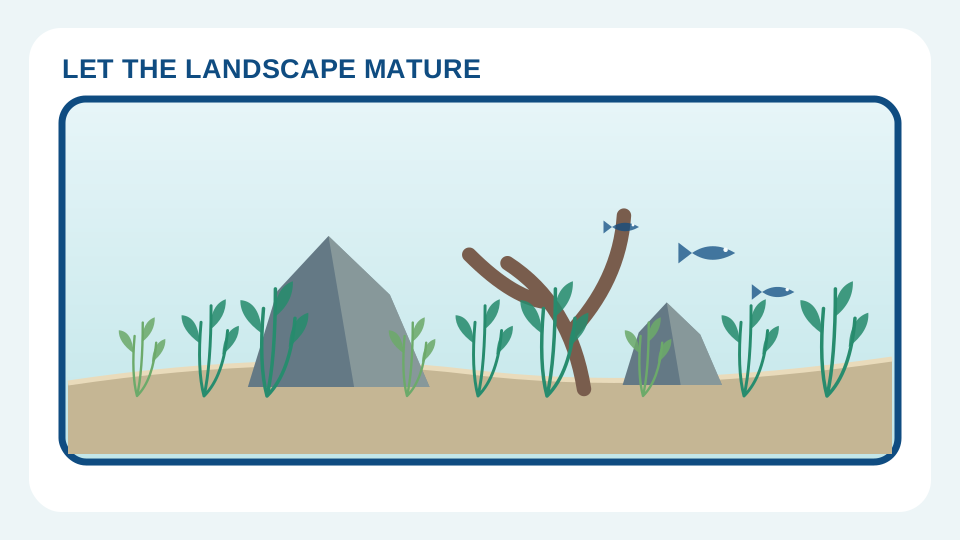
- Let the layout mature. New plants need time to root and fill their intended space. Photograph the tank periodically and trim or replant thoughtfully as the composition develops.
Before You Fill the Tank
- Hardscape is stable and leaves room for cleaning.
- Plant positions and mature heights are planned.
- Equipment is correctly positioned.
- Substrate slopes are secure.
- The main focal point remains clear.
- Plants match the available light and CO₂ conditions.
Low-Tech vs. High-Tech Aquascaping

A low-tech planted aquascape usually uses simpler lighting and no pressurized CO₂ injection. Growth can be slower, but hardy plants still offer many textures and shapes. A high-tech approach commonly combines stronger light, injected CO₂, and more active nutrient management for faster or more demanding growth. The labels are informal; there is no official equipment threshold.
| Factor | Low-tech | High-tech |
|---|---|---|
| Injected CO₂ | Usually no | Common |
| Plant growth | Generally slower | Generally faster |
| Plant selection | Still diverse, but more selective | Broader range |
| Trimming | Often less frequent | Often more frequent |
| Nutrients | Moderate demand | Higher, actively managed demand |
| Beginner fit | Often easier to manage | Requires more consistency |
Low-tech does not mean unattractive, and high-tech is not automatically better. Select plants that suit the system. An attractive, stable aquarium with a sustainable routine is a stronger first result than buying equipment without understanding what it changes.
Maintaining an Aquascape
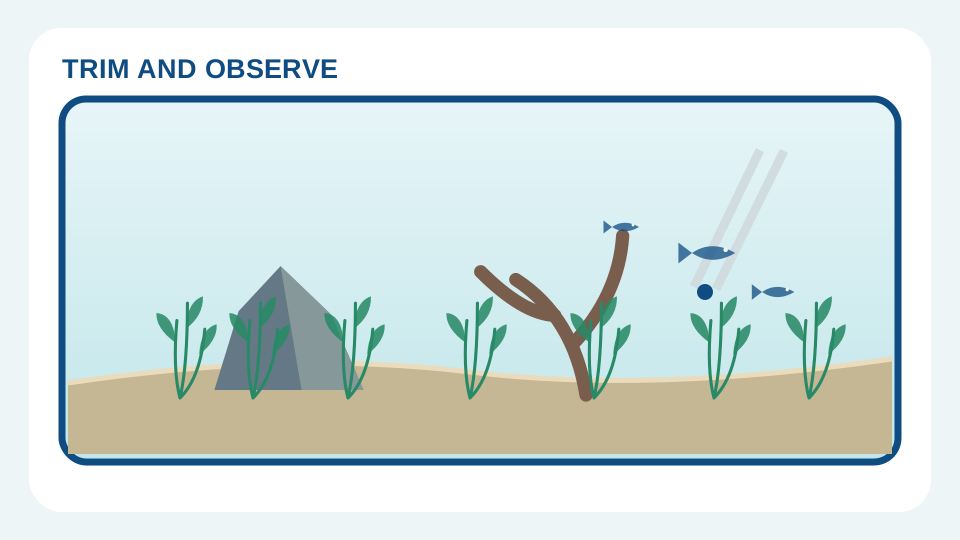
An aquascape is a living arrangement rather than a one-time decoration project. Regular care supports both plant health and the intended composition. Trimming keeps a focal stone visible, replanting a stem group restores depth, and cleaning glass makes the scene readable again.
Regular Tasks
- Make partial water changes suited to the tank's needs.
- Clean aquarium glass and remove damaged leaves.
- Trim overgrowth; replant stems when necessary.
- Check filter performance and circulation behind hardscape.
- Observe livestock and new plant growth.
- Manage nutrient dosing where used.
- Notice algae early and review the conditions behind it.
There is no single maintenance calendar for every tank. Fast growth under bright light may require frequent trimming, while a restrained low-tech design may change more slowly. Keep a simple record of equipment adjustments and plant response so you can learn what your system actually needs.
| Sign | Area to review |
|---|---|
| Persistent algae | Light, nutrients, CO₂ balance, and maintenance |
| Pale or damaged growth | Nutrition, lighting, and species requirements |
| Plants hide the layout | Trimming and placement |
| Debris gathers in one area | Water circulation |
| Hardscape disappears | Plant density and pruning |
These are prompts for investigation, not diagnoses. Several causes can produce the same visible sign. Make measured changes, then give the aquarium time to show a meaningful response.
Common Beginner Aquascaping Mistakes
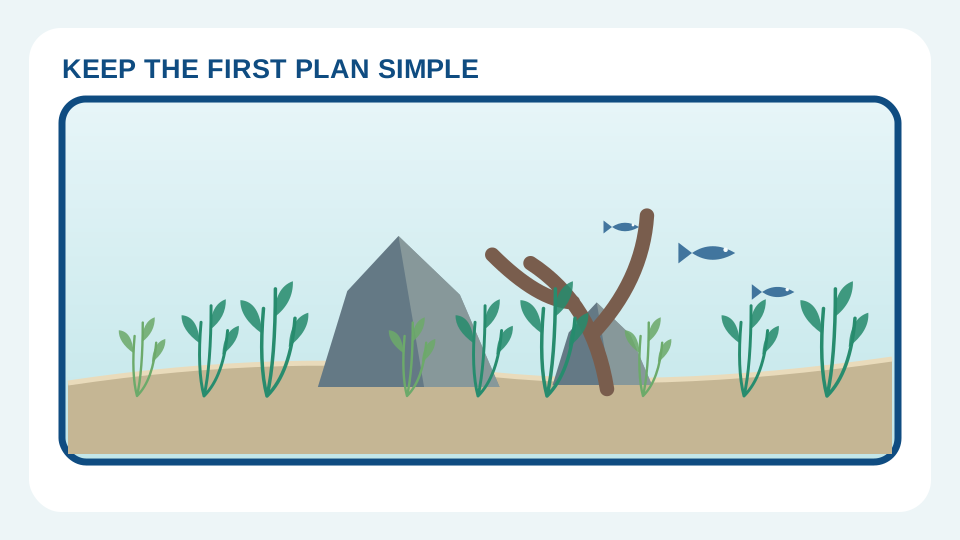
- Buying plants before deciding on a general layout.
- Mixing too many unrelated stones, woods, and decorations.
- Making every element compete for attention.
- Ignoring the mature height and spread of plants.
- Assuming stronger lighting always gives better growth.
- Choosing demanding plants for a simple low-tech tank without checking their needs.
- Filling every open area and losing useful negative space.
- Adding livestock without considering swimming room and behavior.
- Expecting a new planting to look mature immediately.
- Removing algae without checking why it returns.
- Moving new plants repeatedly before they establish.
- Copying advanced display tanks without accounting for their equipment and care.
A Beginner Rule of Thumb
- Start simpler than your inspiration photo.
- Choose plants appropriate for your setup.
- Keep one clear visual direction.
- Give plants time to adapt.
- Change one major variable at a time when troubleshooting.
Frequently asked questions
Frequently Asked Questions About Aquascaping
Short answers for planning a first layout.
What is aquascaping in simple terms?
Aquascaping is the intentional design of an underwater scene inside an aquarium. Plants, rocks, wood, substrate, and open space are arranged as a coherent landscape while the needs of any living organisms are respected.
Is aquascaping the same as a planted aquarium?
They overlap, but the emphasis differs. A planted aquarium grows aquatic plants; an aquascape deliberately arranges the whole visible scene. Some planted tanks are aquascapes, and some hardscape-led designs have few plants.
Is aquascaping difficult for beginners?
It can be straightforward or demanding. A simple plan with hardy plants, suitable light, stable filtration, and regular care is accessible to many beginners. Fast-growing carpets, complex stone layouts, and intensive trimming raise the difficulty.
Do aquascapes need fish?
No. Fish can add movement, but an aquascape may feature shrimp, snails, a suitable mix of livestock, or no animals at all. If you do add animals, plan around their water needs, swimming space, and behavior.
Do I need CO₂ for aquascaping?
Not for every layout. Many hardy plants can grow without injected CO₂ when light and nutrients suit them. Pressurized CO₂ can help demanding species or faster-growing systems, but it brings additional equipment and a need for consistent control.
Can I create an aquascape without live plants?
Yes. A considered underwater arrangement of rocks, wood, sand, and open water can still be an aquascape. Living planted layouts are strongly associated with modern aquascaping, but the defining idea is intentional composition.
What is the easiest aquascaping style for beginners?
No style is universally easiest. A restrained Nature- or Jungle-inspired layout using hardy plants may be more manageable than a demanding carpet or tightly trimmed Dutch display. Choose by the plants, equipment, and routine you can support.
How long does an aquascape last?
A well-maintained layout can evolve for years. Its exact appearance will change as plants grow, stones weather, wood ages, and groups are trimmed or replanted. Maintenance keeps the idea legible while allowing the scene to mature.
How often does an aquascape need maintenance?
It depends on plant growth, light, CO₂ use, livestock, and the desired appearance. Check the tank regularly; perform water changes and cleaning as conditions require, and trim before plants overwhelm the composition.
Can aquascaping be done in a small aquarium?
Yes. Small tanks can make compact scenes especially effective, but water conditions may change quickly. Choose plants and livestock carefully, leave practical room for cleaning, and keep the equipment and maintenance routine consistent.
The Most Important Beginner Takeaway
- Match plants to your setup.
- Prioritize stability.
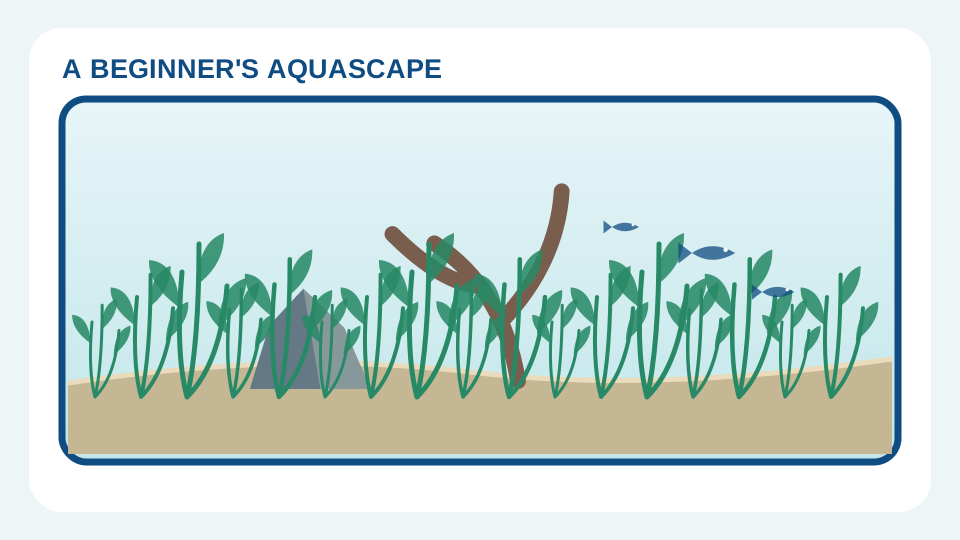
- Keep the first composition simple.
- Allow the aquarium to mature gradually.
Conclusion
Aquascaping Is the Art of Building a Living Landscape
Aquascaping combines visual design with the practical requirements of plants and, when present, aquatic animals. Stones and wood establish a framework; plants and open water shape the view over time. Lighting, filtration, circulation, and routine care keep the setting workable after the first photograph.
You do not need to master a demanding Iwagumi carpet or an injected-CO₂ system before beginning. Learn the basic principles, choose an achievable style, and select plants that match your equipment. Build the hardscape deliberately, establish the aquarium patiently, and maintain it consistently. As you gain experience, you can refine the composition rather than trying to perfect every detail on day one.
The most useful first aquascape is one you can observe, enjoy, and care for. Let it become your own underwater landscape as its plants take root and the design develops.
Ask Aqualume
Questions About an Aquascape?
Tell us about your tank, equipment, or planned layout. Include the details you know, and we will reply by e-mail.

Further reading
Explore More Aquascaping Guides
 Plant health
What Causes Algae Growth in an Aquarium?
Learn how light, nutrients, waste, and plant growth interact in a planted layout.
 Water care
Mechanical, Biological, and Chemical Filtration
Understand filter media, water flow, and the biological side of a planted aquarium.
 Fish care
What Is Dissolved Oxygen in Aquarium Water?
Explore gas exchange, oxygen demand, and surface movement in a planted tank.