From cylinder to planted tank
How Does a CO₂ Diffuser Work?

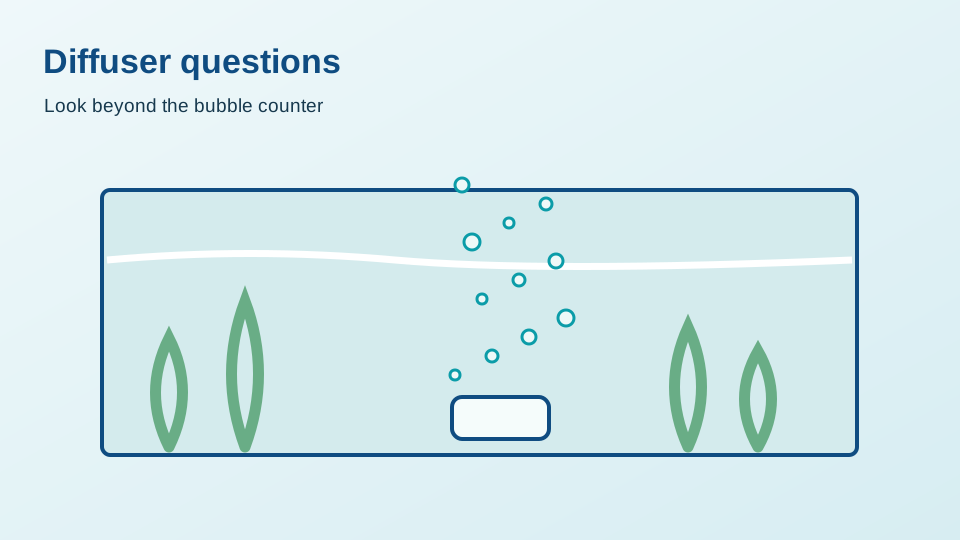
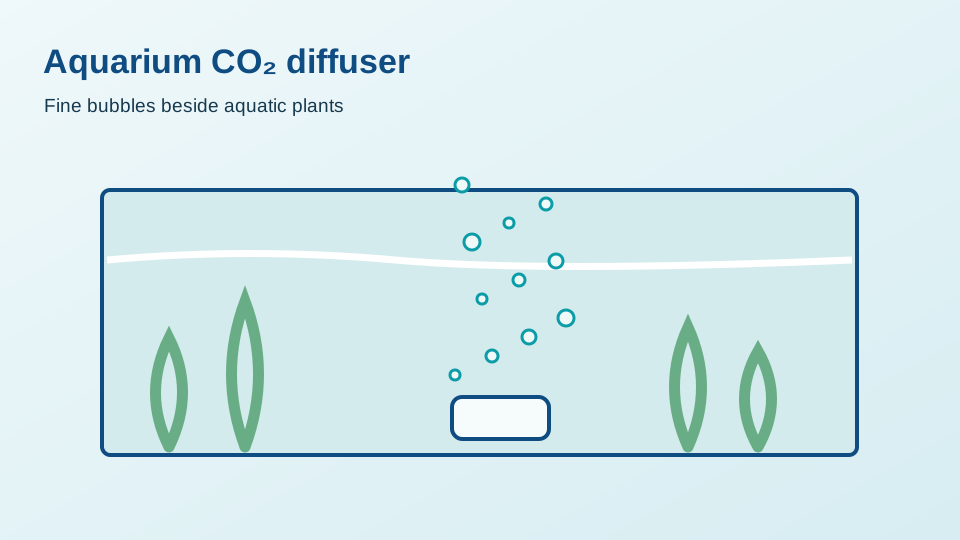
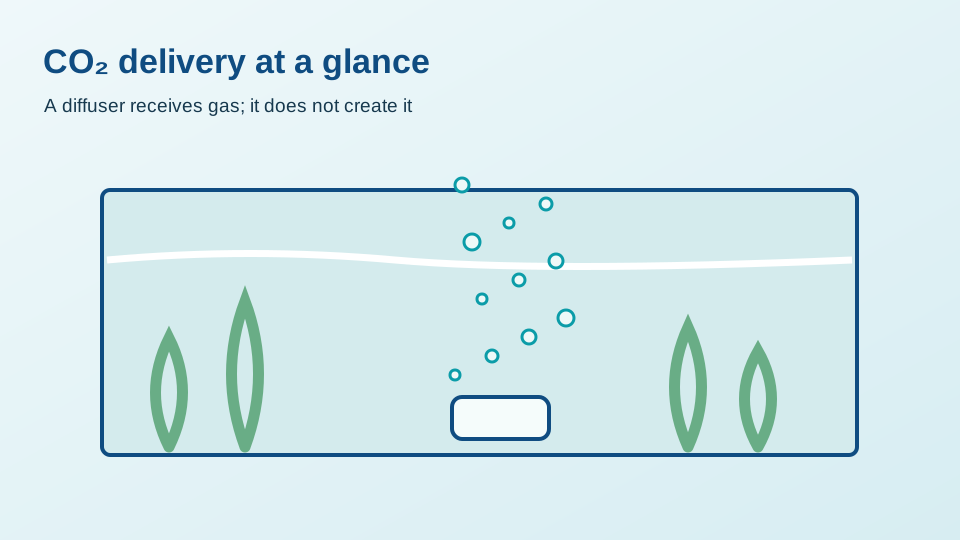
A common in-tank diffuser has a small chamber sealed behind a porous ceramic disc. Gas arriving through tubing builds pressure inside that chamber. When the pressure is sufficient for that particular membrane, CO₂ passes through many small pores and emerges as fine bubbles.
- CO₂ leaves the pressurized cylinder.
- The regulator reduces and manages working pressure.
- Controlled gas moves through suitable CO₂ tubing.
- Gas enters the diffuser's chamber.
- Pressure pushes it through the ceramic pores.
- Microbubbles enter water and exchange CO₂ with it.
Imagine dividing one large bubble into many smaller bubbles while keeping roughly the same amount of gas. The combined small-bubble surfaces expose more gas to surrounding water. Many also remain in the water long enough to dissolve partly on their way upward. This is an opportunity for dissolution, not a guarantee that every bubble disappears before reaching the surface.
| Stage | What happens | Why it matters |
|---|---|---|
| Pressure control | Regulator sets a workable supply | Supports stable delivery |
| Membrane | Gas passes small pores | Creates fine bubbles |
| Water contact | Bubbles meet aquarium water | Allows gas dissolution |
| Circulation | Flow moves gas and water | Spreads CO₂ across plants |
Producing a beautiful mist in one corner is only the first step. If water circulation does not carry CO₂ through the aquascape, distant plants may receive less. The diffuser's pore design, cleanliness, pressure requirement, and placement all affect the visible output.
Where Does the Diffuser Fit in a CO₂ System?
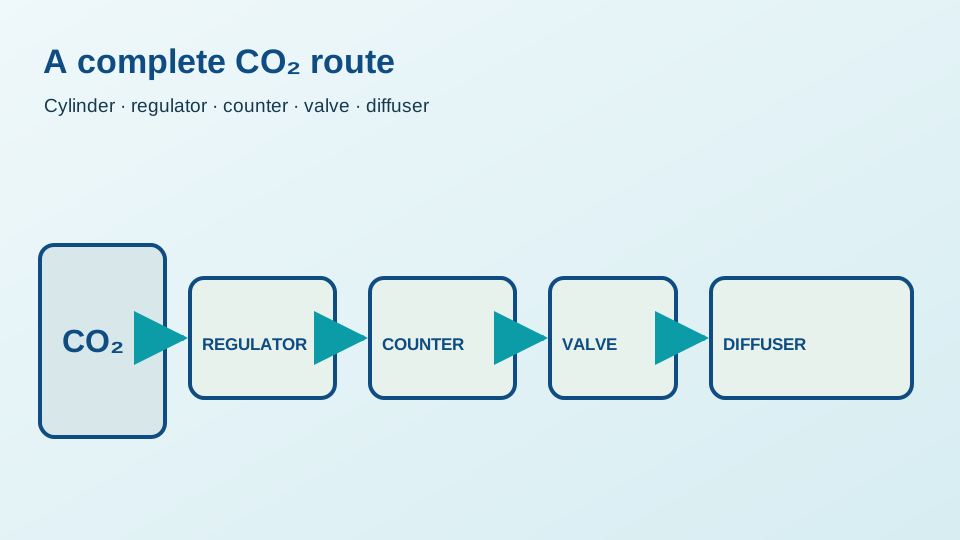
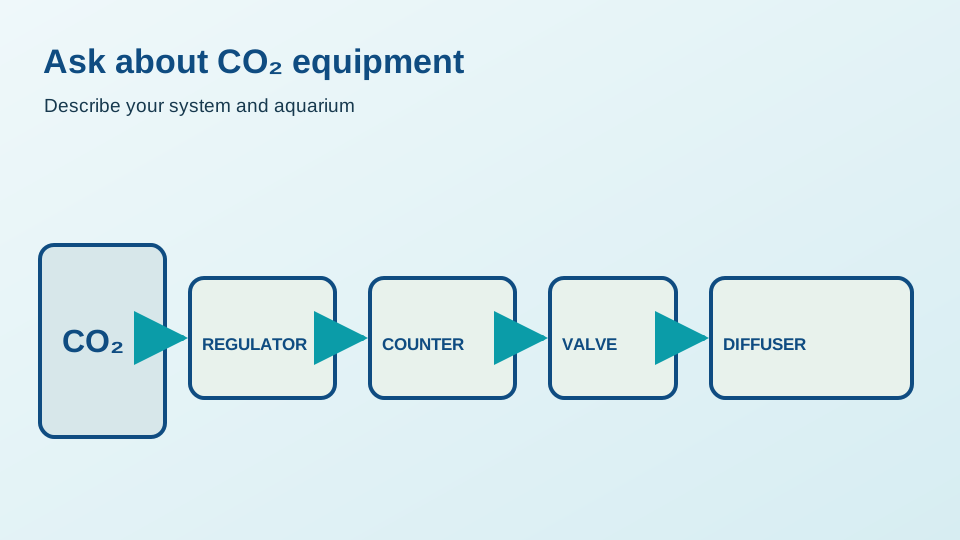
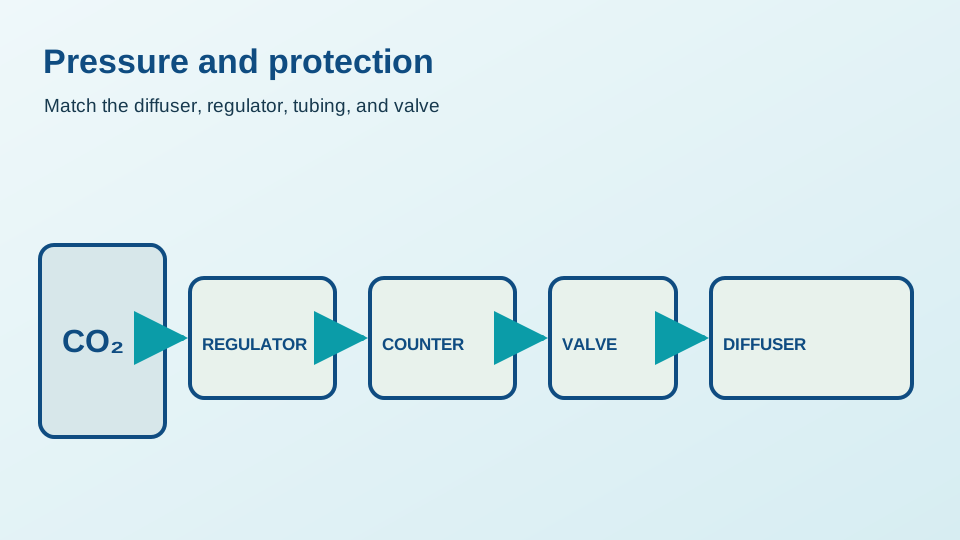
A diffuser is a delivery endpoint. The upstream equipment supplies gas at a suitable and controllable rate. A common route is cylinder → regulator → needle valve and solenoid → bubble counter → CO₂ tubing → check valve → diffuser → aquarium water. Manufacturers may integrate several functions in one body or change their physical order.
| Component | Main function | Common misunderstanding |
|---|---|---|
| Cylinder | Stores pressurized gas | Not the dose control |
| Regulator | Reduces cylinder pressure | Not the diffuser |
| Needle valve | Fine-tunes gas flow | Not a CO₂ measurement |
| Solenoid | Switches flow on and off | Not a pressure reducer |
| Bubble counter | Shows relative bubble rate | Not dissolved-CO₂ testing |
| Tubing | Carries gas between parts | Must suit the equipment |
| Check valve | Helps prevent water backflow | Not a dose control |
| Diffuser | Introduces CO₂ to water | Does not create CO₂ |
The solenoid is often controlled by a timer so gas is not supplied continuously through dark periods when plants are not photosynthesizing. Follow the regulator and system instructions for setup. A bubble counter is most useful when comparing changes on your own equipment; counter chamber size and bubble size differ between products.
Main Types of Aquarium CO₂ Diffusion
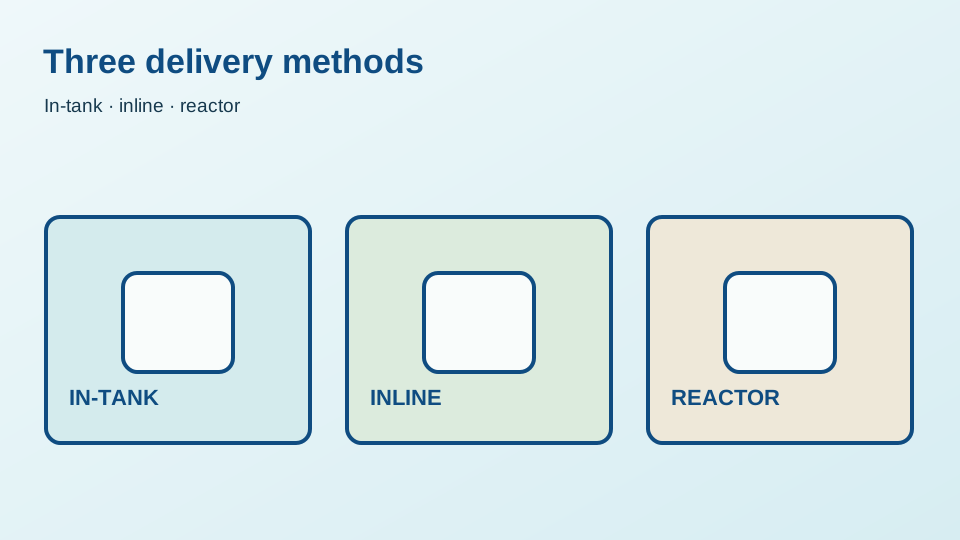
These methods share a goal but are different devices. Choose by filter plumbing, working-pressure compatibility, access for maintenance, and the kind of circulation already present. A reactor aims to dissolve gas in a chamber; it is related to diffusion but is not simply another ceramic disc.
| Method | Location | Main strength | Main limit | Needs |
|---|---|---|---|---|
| In-tank ceramic | Inside aquarium | Easy to see and access | Visible, needs cleaning | Compatible CO₂ system |
| Inline atomizer | External filter return | Less gear in display | Plumbing and pressure constraints | Matching hose and flow |
| Reactor | External water line | Gas-water contact in chamber | Bulk and flow considerations | Suitable pump or filter |
In-Tank Ceramic Diffuser
A disc or membrane releases mist directly into the aquarium. It does not require a canister return hose, and the bubble pattern is easy to inspect. The body remains visible and algae or mineral deposits on the membrane require periodic attention.
Inline Diffuser or Atomizer
This unit mounts in a compatible external filter's return line. It injects fine CO₂ into moving water before that water reaches the aquarium. Hose size, sealing, filter flow, and working pressure are model-specific; it is not a drop-in replacement for every in-tank diffuser.
CO₂ Reactor
A reactor holds gas and moving water together inside a chamber to encourage dissolution before return. It can limit visible mist in the display, but adds equipment and may affect flow if poorly matched. These tradeoffs depend on the product and installation, so there is no universal winner.
In-Tank vs. Inline CO₂ Diffusers

Both can make fine bubbles. The practical difference is where the membrane sits and what equipment is required around it. An in-tank device is simpler to remove for inspection. An inline device relies on suitable external plumbing and can leave the display visually cleaner.
| Decision point | In-tank | Inline |
|---|---|---|
| Installation | Mount inside tank | Fit to return hose |
| External filter | Not required | Usually required |
| Visibility | Body and mist visible | Body outside display |
| Maintenance access | Remove from tank | Open plumbing safely |
| Pressure | Check model specification | Check model specification; often demanding |
| Distribution | Depends on tank circulation | Depends on return flow |
| Simple setup | Often easier | Needs compatible hose |
| Larger, high-flow tank | May still work | Can use existing return path |
An In-Tank Diffuser May Make Sense When
- There is no compatible canister return line.
- You want to inspect bubbles at the point of release.
- Maintenance access inside the tank is straightforward.
- You accept a visible component in the aquascape.
An Inline Diffuser May Make Sense When
- A suitable external filter is already installed.
- The return hose diameter matches a diffuser model.
- The regulator meets that product's pressure requirement.
- You prefer less equipment inside the display.
Why Bubble Size and Water Flow Matter

Smaller bubbles have more surface relative to their gas volume than a single large bubble. They may remain in contact with water longer as they rise, creating more opportunity for CO₂ to dissolve. Membrane pore design and cleanliness influence the bubble pattern, while working pressure determines whether that membrane operates as designed.
Water flow handles the second half of the job. A cloud of microbubbles rising in one narrow column may leave planted areas elsewhere with less CO₂ exposure. Useful circulation can carry mist and CO₂-rich water along the aquarium, around hardscape, and through plant growth. The filter return direction may matter as much as the diffuser's brand.
Signs Distribution May Be Uneven
- Mist remains in one small corner.
- Bubbles rise straight up without being carried by current.
- Hardscape blocks a broad part of the return flow.
- Filter output has declined since the diffuser was positioned.
- Plant response appears uneven after considering light and nutrients too.
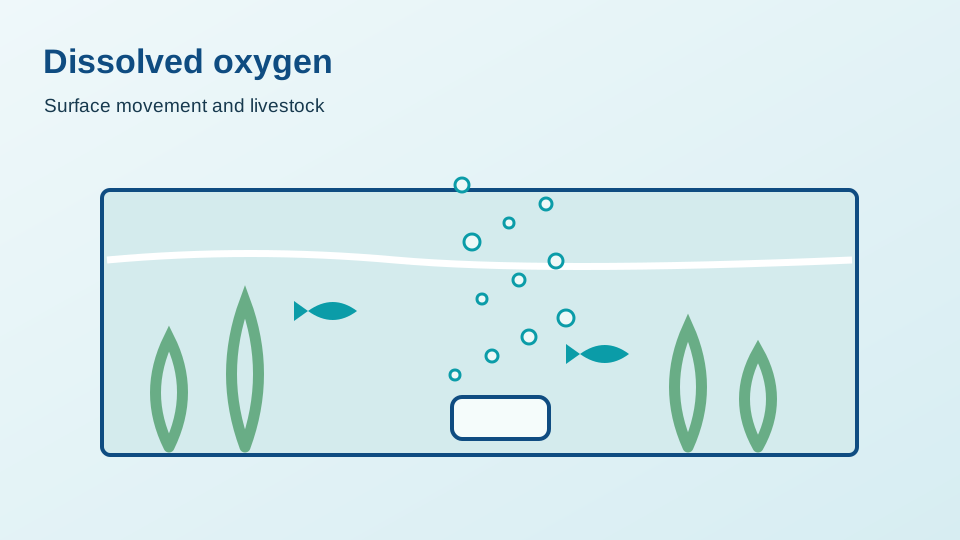
Some bubbles reaching the surface is normal, and visible mist alone cannot measure dissolved CO₂. Observe the whole tank and livestock before making adjustments. The objective is balanced delivery, not trapping every bubble below the surface by eliminating gas exchange.
Where Should You Place a CO₂ Diffuser?
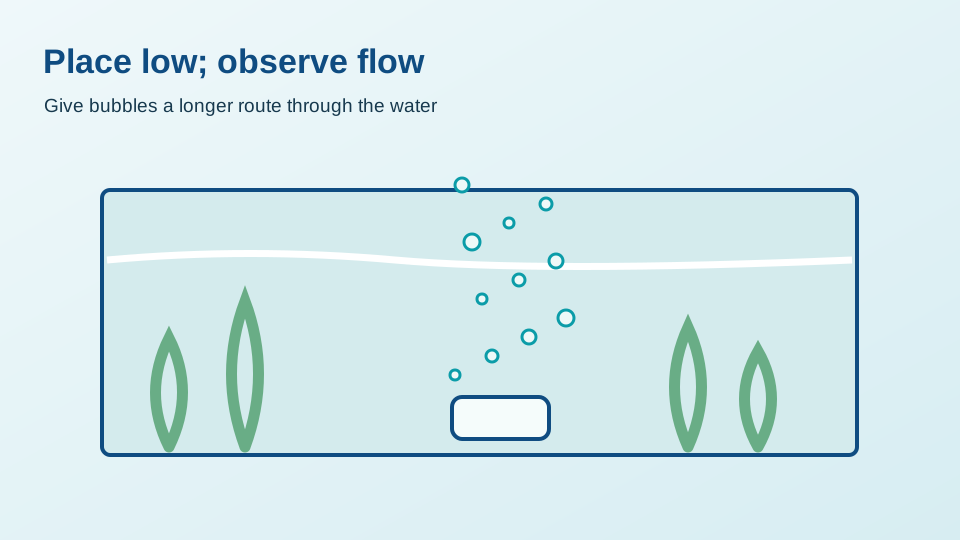
Place an in-tank diffuser relatively low so bubbles travel farther through water. Then use the aquarium's real circulation pattern, not a fixed rule about a particular corner. A filter outlet can catch and carry the mist, but an outlet pointed past the diffuser may leave the bubbles rising vertically.
- Mount the diffuser low within its product instructions.
- Watch the direction of the filter return.
- Choose a location where moving water can carry bubbles.
- Avoid a dead-flow pocket or a straight, rapid rise.
- Observe distant planted areas and adjust placement gradually.
- Keep the ceramic surface accessible for maintenance.
| Good signs | Signs to review |
|---|---|
| Mist enters a visible circulation path | Mist stalls in one corner |
| Flow reaches planted areas | Hardscape blocks the route |
| Animals behave normally | Fish gather abnormally at the surface |
Working Pressure, Tubing, Check Valves, and Bubble Counters
Working Pressure
CO₂ diffuser pressure is product-specific. Fine ceramic membranes and many inline atomizers need enough pressure to overcome membrane resistance. Check the diffuser's specified working range and the regulator's capability; do not impose one number on every model. A no-mist symptom can also reflect a wetting requirement, clogged membrane, or leak.
CO₂ Tubing
Use tubing specified for pressurized CO₂ where the equipment maker requires it. Material, diameter, and fitting compatibility matter, particularly for inline units. Improvised tubing can leak or fail; verify connections without exceeding any component's rating.
Check Valve
A correctly oriented check valve helps prevent aquarium water from siphoning backward toward the regulator when gas flow stops. Some counters or diffusers include one. Confirm what is already integrated before adding another part and follow the maker's placement instructions.
Bubble Counter
A counter gives a repeatable visual reference for adjustments within one system. Bubbles per second is not an absolute measurement of dissolved CO₂. Bubble sizes, water movement, plant demand, and aquarium geometry vary. Watch animals and the overall system rather than chasing a universal bubble count.
| Part | Check | Common mistake |
|---|---|---|
| Diffuser | Pressure rating | Assuming every membrane is alike |
| Tubing | Material and diameter | Using incompatible hose |
| Check valve | Direction and presence | Allowing reverse water flow |
| Counter | Relative change | Treating bubbles as dissolved concentration |
How to Set Up a CO₂ Diffuser
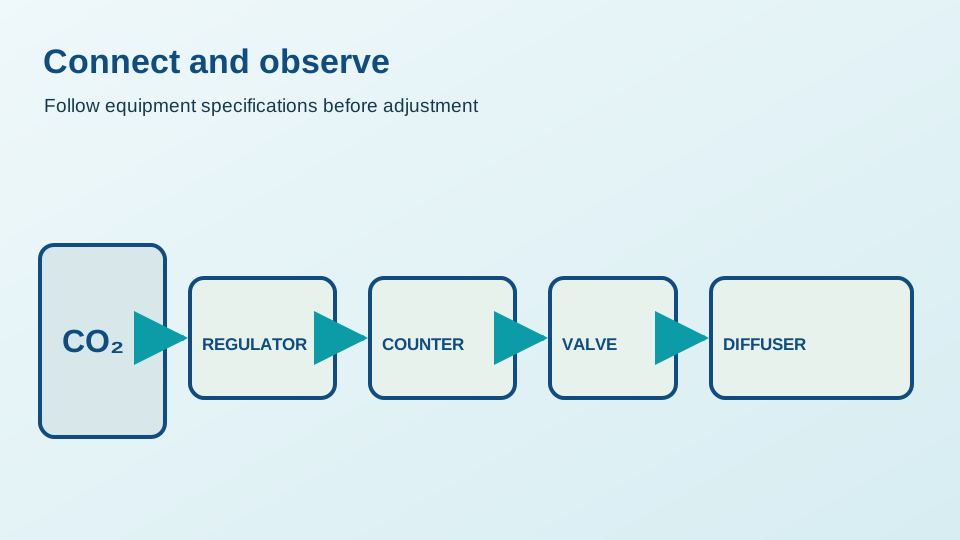
Use the equipment manuals as the authority for fittings, pressure, and preparation. Some ceramic products need pre-soaking; instructions range from a short wetting period to about a day. Do not assume one schedule applies to every membrane.
- Read the diffuser and regulator specifications.
- Confirm working pressure and compatible tubing.
- Pre-soak the ceramic if its maker recommends it.
- Connect the diffuser with suitable CO₂ tubing.
- Install or verify a correctly oriented check valve.
- Place the unit low within a useful flow path.
- Begin with conservative gas delivery.
- Allow the system time to reach operating pressure.
- Look for a reasonably fine, consistent bubble pattern.
- Observe circulation and livestock before gradual changes.
Do not compensate for a clogged membrane by blindly increasing pressure or gas dose. Diagnose the restriction, leak, or setup issue first.
When a new diffuser produces no mist immediately, check the manufacturer's soak instructions and the system's pressure behavior before concluding that the membrane has failed. Give each adjustment time to stabilize, and stay within the rating of the weakest component.
How to Tell Whether a Diffuser Is Working
Signs of Normal Operation
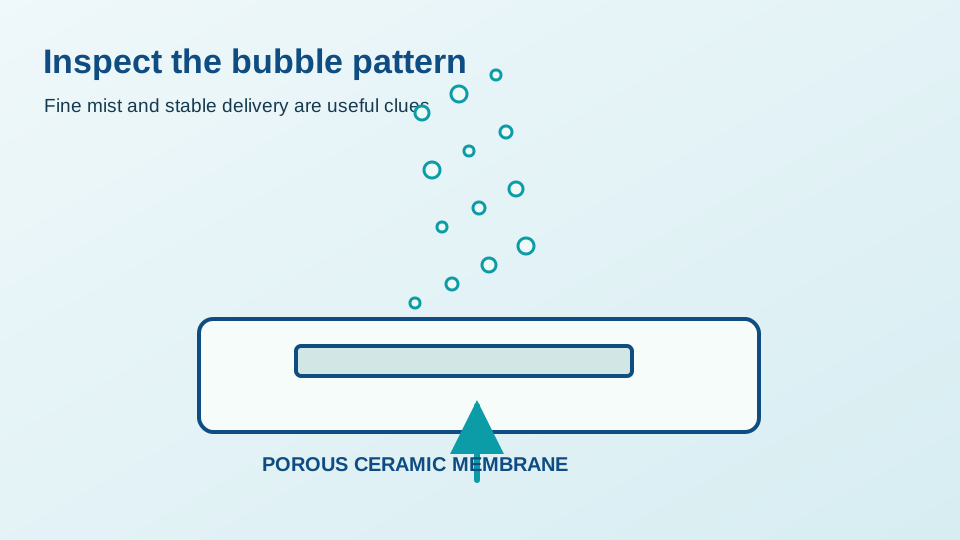
- Fine bubbles or mist emerge after pressure builds.
- Output is reasonably consistent at an unchanged setting.
- Some bubbles are caught by circulation.
- The membrane is free from heavy visible fouling.
- Fish and shrimp behave normally.
Signs Worth Investigating
- The counter moves but nothing exits the diffuser.
- Bubbles have become much larger or output suddenly weaker.
- Mist exits only one small part of a formerly even disc.
- A fitting leaks or gas delivery becomes unstable.
- The membrane is increasingly discolored or blocked.
Bubbles do not need to emerge with perfect geometric uniformity from every pore. Compare the unit with its own earlier performance, not a photograph of another model. A bright mist does not by itself establish a safe or ideal dissolved-CO₂ level.
Cleaning and Maintaining a CO₂ Diffuser
Algae, biofilm, minerals, and fine debris gradually collect on a membrane. The pattern may become coarser or less consistent, and gas may stop passing through some areas. Cleaning needs depend on the tank and material, so let performance and the product's instructions guide service rather than a universal calendar.
Maintenance Checklist
- Compare bubble size and output with normal performance.
- Inspect the ceramic for visible deposits or damage.
- Follow the diffuser maker's approved cleaning process.
- Rinse thoroughly after cleaning and dechlorinate where instructed.
- Inspect tubing, fittings, and the check valve.
- Replace a damaged or persistently blocked membrane if possible.
Cleaning chemistry differs across materials. Some manufacturers allow an appropriately diluted bleach or peroxide method; others specify a different process. There is no safe universal concentration to apply to every diffuser. If a maker permits bleach, thoroughly rinse and carry out its dechlorination steps before the unit returns to livestock water.
| Symptom | Possible cause | First action |
|---|---|---|
| Larger bubbles | Dirty or damaged membrane | Inspect and clean as specified |
| Weak mist | Clogging or insufficient pressure | Check both safely |
| No output | Pressure, blockage, or leak | Trace the system |
| Bubbles at fitting | Loose or damaged connection | Stop and inspect fitting |
Common Diffuser Problems and Troubleshooting
Start with the gas path, then inspect the membrane and water flow. A bubble counter can be active while pressure at the diffuser is still inadequate, a connection leaks, or the ceramic is blocked. An inline device also depends on the external filter's return flow.
| Problem | Likely causes | What to check |
|---|---|---|
| Counter moves; no mist | Pressure threshold, leak, blockage | Rating, fittings, soak instructions |
| Large bubbles | Dirty or damaged ceramic | Membrane and product cleaning method |
| One area emits bubbles | Uneven fouling or pore variation | Compare past output; inspect disc |
| Mist has declined | Deposits, low supply, loose joint | Membrane, regulator, connections |
| Bubbles rise directly | Placement or weak circulation | Return direction and filter flow |
| Inline mist is poor | Hose, pressure, or flow mismatch | Model ratings and return line |
| Output changes | Pressure or connection instability | Regulator, valve, tubing |
| Water enters tubing | Missing or faulty check valve | Valve orientation and condition |
Do not solve every issue by increasing pressure. The correct response to a fouled membrane is often proper cleaning or replacement; the response to poor circulation may be a changed outlet angle. If livestock shows distress, attend to it before optimizing bubble appearance.
CO₂ Diffuser vs. Air Stone

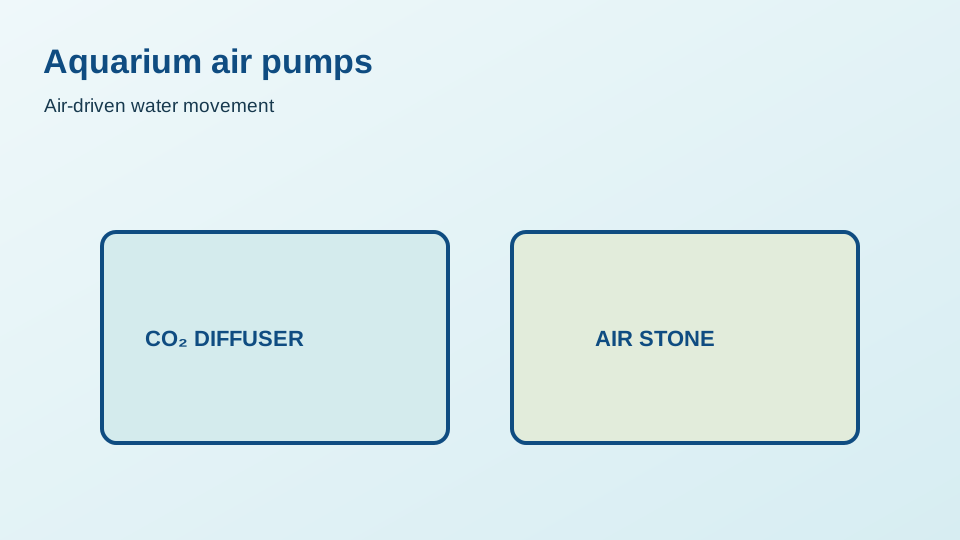
An ordinary air stone usually receives atmospheric air from an air pump to create bubbles, circulation, and surface agitation. A planted-tank CO₂ diffuser receives pressurized carbon dioxide and is designed to make a fine mist suitable for CO₂ delivery. The devices and their pressure sources are not automatically interchangeable.
| Feature | CO₂ diffuser | Air stone |
|---|---|---|
| Main gas | Cylinder CO₂ | Usually room air |
| Purpose | Supplemental planted-tank CO₂ | Aeration and movement |
| Supply | Regulator and suitable system | Air pump |
| Pore design | Often fine ceramic membrane | Designed for air delivery |
| Interchangeable? | Not automatically | Not automatically |
An air stone can be valuable in a planted aquarium for gas exchange, especially when livestock needs more oxygenation. That does not make it equivalent to a high-pressure ceramic CO₂ diffuser. Read the specifications before connecting any device to a pressurized system.
How to Choose the Right CO₂ Diffuser
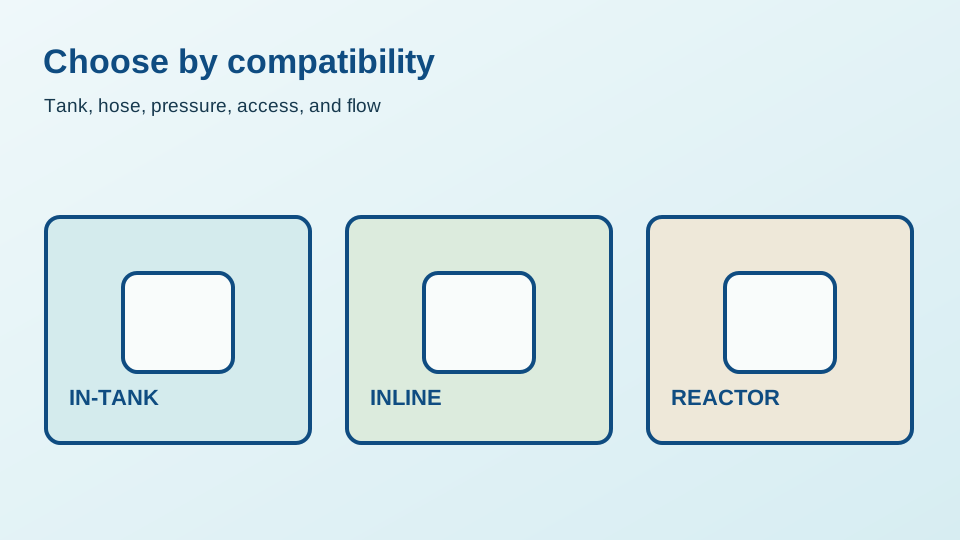
Begin with equipment compatibility and circulation, not a ranking of brands. Tank size helps narrow product ratings, but the diffuser also has to match a regulator, the available hose or plumbing, and the maintenance access you actually have.
Compatibility Checklist
- Aquarium volume, plant density, and existing water movement.
- Filter type and whether an external return hose is available.
- Exact hose diameter for an inline model.
- Required working pressure and regulator capability.
- Appropriate CO₂ tubing and fittings.
- Ceramic quality, replacement parts, and cleaning directions.
- Preference for visible in-tank equipment or external plumbing.
- Clear manufacturer documentation for setup and service.
| Situation | Method to consider |
|---|---|
| Simple planted setup | In-tank ceramic diffuser |
| Compatible canister return | Inline diffuser or atomizer |
| Minimal visible mist desired | Suitable reactor |
| Weak or uneven flow | Improve circulation before buying another diffuser |
CO₂ Diffusers and Aquarium Livestock Safety

Injected CO₂ changes the aquarium environment. Excessive delivery can stress fish and shrimp, and reducing all surface movement to retain gas can compromise oxygen exchange. More CO₂ is not automatically better. Adjust conservatively and watch animals whenever the dose, flow, or diffuser placement changes.
Warning Signs to Watch
- Persistent gasping or rapid breathing.
- Unusual gathering at the water surface.
- Sudden abnormal behavior after a CO₂ adjustment.
- Shrimp or fish appearing distressed as flow or lighting changes.
If animals appear distressed, prioritize their safety: stop or reduce CO₂ injection as appropriate and improve aeration or surface gas exchange while checking the cause. Test relevant water conditions rather than assuming CO₂ is the only possible issue. Keep circulation and oxygenation suitable for the livestock even when plant growth is a main goal.