
The practical comparison
What Are Ceramic Rings?

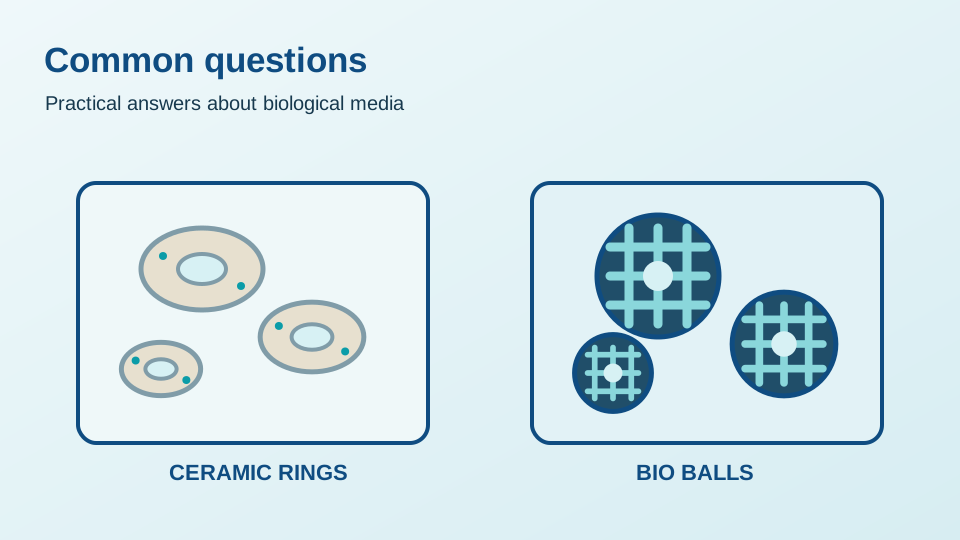
Ceramic rings are usually fired or sintered pieces with a central opening and a textured body. The hole allows water to pass between pieces; the outer surface and accessible pores offer places for biofilm to attach. Their exact pore sizes, strength, and usable surface differ by product, so “ceramic ring” is a category rather than one fixed performance specification.
In a submerged chamber, oxygenated aquarium water circulates around the rings. The microbes on wetted, reachable surfaces perform nitrification. The ceramic itself does not chemically remove ammonia merely because it is porous. Fine particles can also enter pores, which is one reason a mechanical stage before the rings matters.
Common places for ceramic rings
- Canister filters and reusable hang-on-back media compartments.
- Internal filters with room for a biological basket.
- Submerged sump chambers.
- Freshwater setups and suitable marine biological stages.
Rings are convenient when filter space is limited and a stable submerged flow path exists. Do not press them so tightly together that most water bypasses the basket. Some low-quality or old pieces may crumble when handled; damaged pieces can be changed in stages without discarding all established media.
The size of the central channel is useful only if water can reach it. A bag packed into a narrow basket may direct water around its edge, while a looser layer lets more surfaces participate. Follow the filter maker’s loading guidance and observe the actual water route rather than assuming every visible pore receives the same circulation.
What Are Bio Balls?

Traditional bio balls are lightweight plastic pieces with fins, pins, or an open lattice. The exposed plastic provides attachment sites while leaving generous channels for moving water. This guide means those traditional plastic pieces, not a ceramic product that happens to be sold under a similar name.
Bio balls became familiar in wet/dry filters, trickle towers, pond filters, and sumps. In a trickle stage, water passes over the media while air remains around it, giving nitrifiers ready access to oxygen. A fully submerged bio ball can also support bacteria when water is oxygenated; it simply loses some of the distinct air–water advantage of wet/dry operation.
Typical plastic bio ball features
- Open, lightweight, and usually durable construction.
- Exposed surfaces with relatively low resistance to flow.
- Easy access for a gentle rinse.
- Strong fit for oxygen-rich, high-flow stages.
- No tiny ceramic-style pores that can fill with fine waste.
The open form still collects debris if a system has inadequate pre-filtration. It may also use more chamber volume than compact porous ceramic in some submerged filters. A design with ample space can accommodate that tradeoff, while a very small chamber may not.
In a wet/dry tower, uniform water distribution matters. If a spray bar wets only one side of the chamber, the rest of the balls contribute less than their volume suggests. Likewise, a submerged basket still needs an intake and outlet that direct water through the media, not merely around it.
Ceramic Rings vs Bio Balls

The comparison below describes common forms, not a guarantee for every brand. Media size, pore structure, packing density, and the surrounding filter can change actual performance. In both columns, established microorganisms do the biological work.
| Feature | Ceramic rings | Plastic bio balls |
|---|---|---|
| Material | Fired or sintered ceramic | Usually inert plastic |
| Structure | Ring with outer and internal pores | Open lattice, fins, or pins |
| Main role | Habitat for aerobic nitrifiers | Habitat for aerobic nitrifiers |
| Bacterial environment | Oxygenated outer surfaces; deeper conditions vary | Strongly oxygenated exposed surfaces |
| Internal porosity | Often substantial, product dependent | Little ceramic-style microscopic porosity |
| Water flow | Good when the bed stays open | Excellent through open geometry |
| Gas exchange | Depends on dissolved oxygen in flowing water | Especially strong in wet/dry use |
| Space efficiency | Can fit much usable area in compact space | Often needs more physical volume |
| Clogging | Fine pores can become fouled | Surface debris can collect, but no fine ceramic pores |
| Cleaning | Gentle rinse; protect fragile pieces | Open form is easy to rinse gently |
| Durability | Varies; some pieces chip or crumble | Usually highly durable |
| Typical setting | Submerged canister or biological chamber | Wet/dry sump, trickle tower, pond |
| Practical strength | Compact porous surface | Flow, oxygen exposure, and access |
| Main limit | Pore fouling if fine waste reaches it | Less compact in many submerged baskets |
Why Surface Area Can Mislead

Packaging often emphasizes a very large surface-area number. The number may include microscopic spaces that water, oxygen, or the relevant microbes cannot use effectively in a working filter. Different manufacturers may also use different measurement methods, so two printed figures are not necessarily comparable.
A biofilm must have contact with flowing water to receive dissolved nitrogen waste. Its active outer layer also needs oxygen for nitrification. As biofilm thickens and debris gathers, transport into deeper pores changes. A large laboratory figure can therefore coexist with weak practical performance in a clogged or bypassed media bed.
Questions beyond the area number
- Can aquarium water reach the claimed surface?
- Can enough oxygen reach the nitrifying biofilm?
- Will fine waste plug access to small pores?
- Does the actual basket direct water through the media?
- Is the medium submerged or exposed to air in a trickle stage?
- Does the maker explain how it measured area?
High-quality porous ceramic may offer more microscopic area within the same volume, but this does not prove a fixed amount of additional living bacteria. Open plastic media may have less microscopic area while providing excellent exposure and an easier-to-maintain water path. Judge the complete filter, not a single specification.
When comparing two products, check whether area is stated per piece, per liter of loose media, or per unit of filter chamber. Those are different denominators. A useful measurement should also explain its method and conditions; without that context, the safest conclusion is only that the products have different physical structures.
Oxygen and Water Flow

Aerobic nitrification consumes oxygen. Bio balls were shaped to expose surfaces to water and, in a wet/dry stage, to air between trickles. Ceramic rings can also nitrify effectively underwater when the filter continuously supplies oxygenated water. Their success does not require exposure to the atmosphere.
Flow should contact the media without washing everything past an empty channel. Packing either medium too tightly, leaving a clogged intake, or allowing water to bypass a basket reduces contact. A stagnant pocket can turn a promising media purchase into unused volume.
Warning signs of poor flow
- Noticeably reduced filter output.
- Heavy sludge within the biological chamber.
- Water visibly bypassing most of the media.
- A basket so full that circulation is restricted.
- A mechanical pad clogged before the biological stage.
Check the whole water path before replacing media. Cleaning an intake or pre-filter may restore the conditions the mature biofilm needs. A pump rating on the box does not reveal the flow through a particular dirty basket after weeks of use.
Oxygen in the tank itself can change with temperature, surface movement, plant respiration, and stocking. A wet/dry stage is good at exposing media to air, but it cannot compensate for every aquarium-wide problem. If fish behavior changes or measured ammonia rises, assess the tank and its circulation together.
Can Ceramic Rings Remove Nitrate?
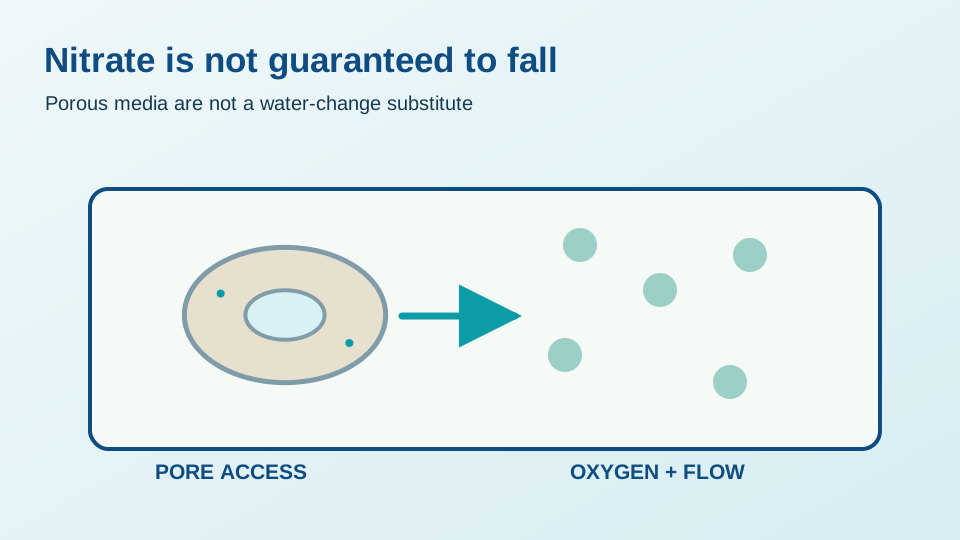
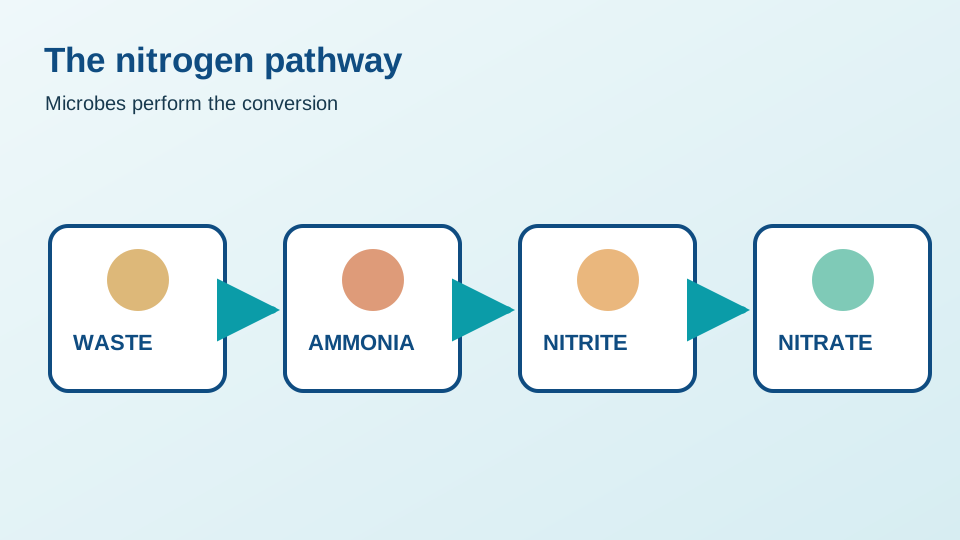
Ceramic rings are primarily a place for nitrification: established microbes help convert ammonia to nitrite and nitrite to nitrate. Some porous media can develop lower-oxygen microzones deeper inside a biofilm or pore network. Different microbes could then carry out nitrate-reducing processes if other conditions, including a suitable carbon source, are present.
That possibility is not a promise that an ordinary ring basket will reduce a measurable amount of nitrate. Pore shape, water movement, biofilm thickness, oxygen penetration, and organic supply all matter. Evidence from engineered denitrifying filters cannot simply be transferred to every household aquarium cartridge.
Key points
- Ammonia control: a major biological-filtration role.
- Nitrite control: another major biological-filtration role.
- Nitrate reduction: possible in specific conditions, never guaranteed by ring shape alone.
- Water changes and other appropriate nutrient management remain useful.
If nitrate is rising, examine feeding, stocking, plant uptake, source water, and the maintenance routine. Replacing all biological media in search of a nitrate cure risks losing the established nitrifying community while leaving the real cause untouched.
Some products advertise nitrate reduction based on controlled trials or unusual media geometry. Read what was actually measured, whether the medium was used in a specially operated reactor, and whether its conditions resemble your filter. Nitrate reduction observed in one engineered system is not a general property of every porous ring.
Which Medium Clogs More Easily?

Fine ceramic pores can gradually collect detritus, particles, organic sludge, and thickening biofilm. Bio balls can also become coated with waste, but their open surfaces are generally easier to reach when cleaning. Neither design excuses a filter that sends a constant load of solids straight into the biological chamber.
The more useful fix is often upstream. A sponge, pad, or other mechanical stage captures particles before they settle in the biological media. Its placement must follow the actual direction of water through the filter; “top first” is not a universal rule.
Reduce clogging
- Place mechanical capture before biological media in the water path.
- Clean pre-filter sponges or pads when flow falls.
- Leave enough room for water to move around the pieces.
- Swish biological media gently only when it needs cleaning.
- Do not scrub established surfaces until sterile.
A slight brown coating does not mean the medium has failed. Dense deposits that reduce flow deserve attention, particularly when the filter outlet becomes weaker. Inspect mechanical filtration first, then the biological stage if the problem remains.
When cleaning, aim to remove loose trapped debris while keeping the colonized material in service. A vigorous wash may briefly make media look attractive but can take away more of the working biofilm than necessary. If one basket is heavily loaded, cleaning it separately from another mature basket may reduce disruption.
Which Medium Fits Each Filter?

Filter design is more useful than a universal ranking. Consider the physical chamber, the direction of flow, whether the media is submerged, and whether air enters the biological stage. The table offers practical starting points rather than rigid rules.
| Filter | Ceramic rings | Bio balls | What to check |
|---|---|---|---|
| Canister | Very practical in baskets. | Can work, but may take more space. | Prefilter and real basket flow. |
| HOB | Good in reusable media chambers. | Small pieces can work if water passes through. | Available chamber depth. |
| Internal | Often easier to fit. | Possible with enough room. | Compact volume and access. |
| Submerged sump | Useful and compact. | Also suitable. | Volume, oxygen, and maintenance. |
| Wet/dry sump | Possible in a suitable stage. | Particularly well suited. | Reliable trickle distribution. |
| Trickle tower | Less typical. | Open pieces suit the setting. | Air and water exposure. |
| Pond filter | Can fit protected chambers. | Durable, easy-access option. | Solids load and service access. |
| Limited space | Can use compact volume well. | May be less space-efficient. | Water must still move freely. |
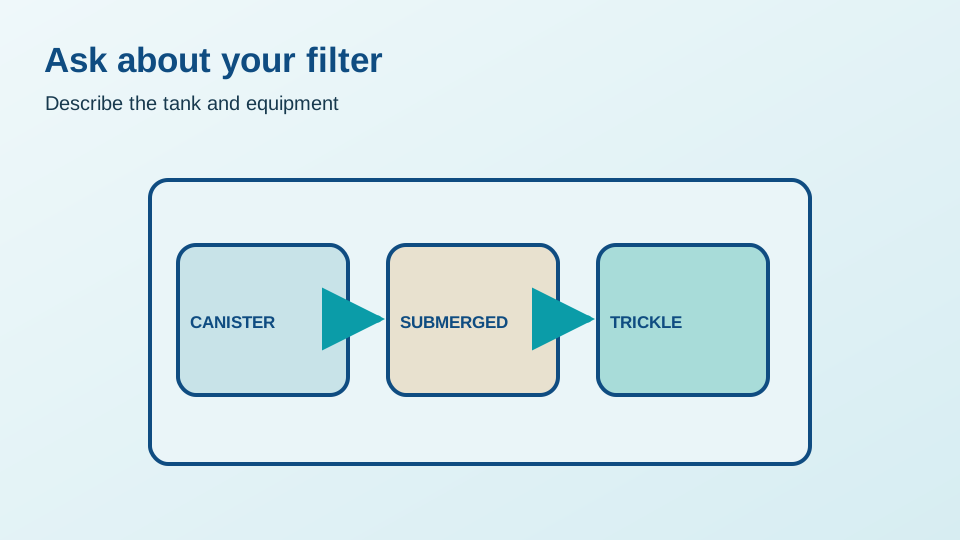
Marine and freshwater systems both need nitrification, but the wider filter design may differ. A sump might use open wet/dry media in one chamber and submerged rings in another. A small HOB cartridge may have no useful room for either; forcing extra pieces into it can make the water path worse.
Before buying media, open the filter and measure the usable compartment rather than the outer housing. Note where incoming water first meets a sponge or pad and where it exits. Then consider whether the selected pieces can be lifted out for a gentle rinse without dismantling the entire system.
How to Maintain Both Media

Established media should be maintained to preserve flow and biofilm, not made to look new. Cleaning frequency depends on fish load, feeding, mechanical filtration, filter size, and actual dirt accumulation. There is no useful mandatory monthly replacement schedule for either type.
- Maintain the mechanical stage first.
- Inspect the biological stage when flow drops or visible waste collects.
- During a water change, collect some removed aquarium water in a clean bucket.
- Gently swish dirty rings or balls in that water, or use suitable dechlorinated water.
- Leave established surfaces intact; do not scrub every piece.
- Return the media promptly and restart normal flow.
- Do not replace every mature piece at the same time.
- Replace a damaged or unusable portion gradually if needed.
Heavily chlorinated tap water can harm the microorganisms you are trying to keep. Similarly, leaving biological media dry or without circulation for an extended service period can disrupt it. Work efficiently, keep pieces wet, and check water tests after a major filter change.
Avoid during routine maintenance
- Bleaching or sterilizing established biological media.
- Replacing all media because it has turned brown.
- Cleaning every biological compartment aggressively at once.
- Assuming a new bag of media is already biologically mature.
Plastic balls generally remain structurally sound for years. Ceramic rings may last well too, but some can chip, crumble, or become too fouled to maintain. A physical problem, not a calendar date, is the reason to replace an individual batch.
Can You Use Both Together?
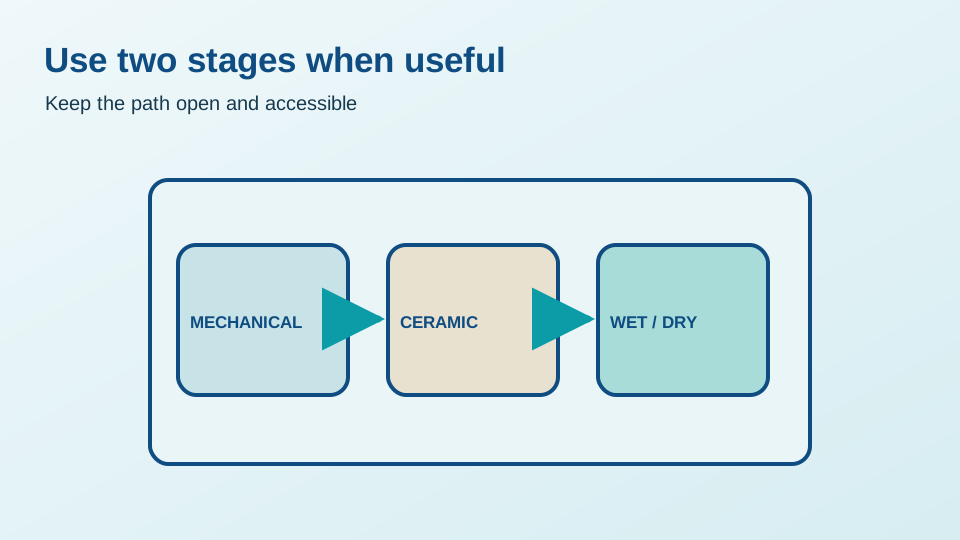
Yes. A multi-stage system might send water through a mechanical pre-filter, then a submerged chamber of ceramic rings, then a trickle section filled with bio balls. Each stage has a clear purpose, and the water path remains open. An all-submerged sump can also use both, though the benefits depend on its actual layout.
Combining media does not automatically double biological capacity. The microbes still need waste, oxygen, and water contact, while maintenance access must remain practical. A simple, correctly sized filter can work better than a crowded basket full of redundant products.
Using both makes sense when
- The filter has distinct biological stages.
- A sump includes submerged and trickle sections.
- The waste load warrants additional usable habitat.
- You can reach each stage for maintenance.
- The extra media does not restrict water flow.
Where only one small chamber exists, start by protecting it with adequate mechanical filtration and keeping it open to flow. More varieties of media will not repair a clogged intake or an uncycled aquarium.
Which Should You Choose?

Choose ceramic rings when
- Space is limited in a canister or submerged media chamber.
- You want compact porous biological media.
- A mechanical pre-filter protects the pores from fine waste.
- The chamber delivers steady oxygenated water.
Choose plastic bio balls when
- You run a wet/dry or trickle filter.
- Open water paths and gas exchange are priorities.
- You have room in a larger sump or pond chamber.
- Durability and quick access for gentle maintenance matter.
Either can work when
- The aquarium has an established biological cycle.
- Mechanical media catches much of the solid waste first.
- Water and oxygen reach colonized surfaces.
- The media volume suits the real livestock and feeding load.
- Cleaning preserves the living colony.
In a new aquarium, monitor ammonia and nitrite while the filter matures, regardless of which medium you choose. In an established tank, preserve at least part of the old media when making a change. The better medium is the one that matches the filter environment.